
Have you ever written per say or per se and wondered which spelling is correct? You are not alone. Many students, English learners, and even native speakers confuse these two expressions because they sound almost identical in everyday conversation. However, only one is the correct expression in standard English.
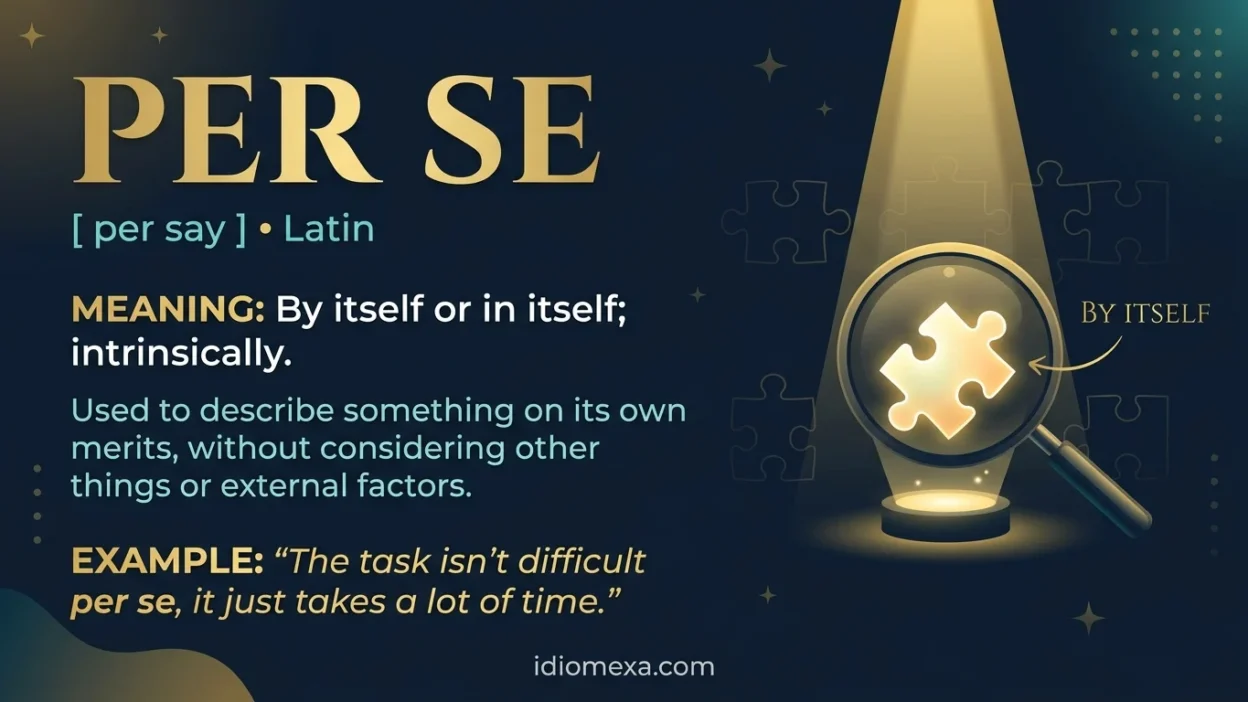
The correct spelling is per se, not per say. It is a Latin phrase that means “in itself,” “by itself,” or “intrinsically.” People use it when they want to describe something in its own right rather than its connection to something else. For example, “The idea is not bad per se, but its execution needs improvement.” Understanding this phrase will help you use it naturally in conversations, academic writing, professional communication, and everyday English. In this guide, you will learn its meaning, pronunciation, spelling, differences, and practical examples.
Quick Answer: Per Say or Per Se?
Per se is the correct spelling, while per say is a common spelling mistake. The phrase comes from Latin and means “in itself” or “by itself.” It is used to describe something independently, without considering other factors. For example: “Money is not the problem per se.” Remember to write se, not say.
Why Do People Confuse Per Say and Per Se?
People confuse these expressions mainly because of their pronunciation.
In everyday English, per se is pronounced approximately as per say. This makes it easy to assume that the final word should be spelled “say.”
However, pronunciation and spelling do not always match, especially with expressions borrowed from other languages.
Here are the main reasons for the confusion:
- Similar pronunciation: Per se sounds like “per say” when spoken.
- Unfamiliar Latin origin: Many English learners do not recognize that it comes from Latin.
- Spelling assumptions: People naturally connect the sound “say” with the familiar English word say.
- Limited exposure: Some people hear the expression in conversations but rarely see it written.
The important thing to remember is that per say is not a standard English expression. The correct form is always per se.
First Word: What Does Per Mean?
The word per comes from Latin and is commonly used in English.
Depending on the context, it can mean:
- For each: $10 per person.
- For every: Three times per week.
- According to: As per the instructions.
In the expression per se, however, it is part of a fixed Latin phrase. You should understand the complete expression rather than translate each word separately.
For example:
- The fee is $20 per person.
- The company produces 500 units per day.
- The product is not harmful per se.
In the third sentence, per se means that the product is not harmful in itself.
Second Word: What Does Se Mean?
Se is a Latin word meaning “itself” or “oneself,” depending on the grammatical context.
It is not commonly used as an independent English word in everyday writing. Instead, it appears in established Latin expressions.
In per se, the word se helps communicate the idea of something considered in itself.
For example:
“The plan is not expensive per se.”
This means that the plan is not expensive in itself, although other factors might make it costly.
Per Say vs Per Se: Comparison Table
| Feature | Per Se | Per Say |
| Correct spelling | Yes | No |
| Standard expression | Yes | No |
| Origin | Latin | Incorrect spelling of per se |
| Pronunciation | Per say | Usually intended to sound the same |
| Meaning | In itself; by itself | No standard meaning |
| Usage | Formal and informal English | Spelling mistake |
Remember: If you want to express the meaning “in itself,” always write per se.
When Should You Use Per Se?
Use per se when you want to describe something independently or distinguish its actual nature from other related factors.
It is especially useful in these situations:
1. When Discussing Something Independently
Use it when describing something in its own right.
Example: “The design is not complicated per se.”
Meaning: The design itself is not complicated.
2. When Making a Clarification
Use it to explain that something is not necessarily the real issue.
Example: “I don’t dislike the job per se; I just dislike the working hours.”
Meaning: The job itself is not the problem.
3. In Academic Writing
The expression can help make explanations more precise.
Example: “The theory is not incorrect per se, but the available evidence is limited.”
4. In Professional Communication
It can help distinguish between a problem and its surrounding circumstances.
Example: “The service is not expensive per se, but additional charges increase the total cost.”
5. In Everyday Conversations
You can also use it in ordinary discussions.
Example: “I’m not against exercise per se; I just prefer walking.”
12 Examples of Per Se in Sentences
Here are 12 practical examples to help you understand how to use per se correctly.
- Money is not the problem per se; poor financial planning is.
- The movie was not boring per se, but it was too long.
- I’m not against social media per se; I just think people should use it wisely.
- The task is not difficult per se, but it requires patience.
- Being busy is not a bad thing per se.
- The product is not expensive per se, but shipping costs are high.
- There is nothing wrong with making mistakes per se.
- The restaurant is not bad per se, but the service could improve.
- The rule is not unfair per se, although its application may be problematic.
- Technology is not dangerous per se; its impact depends on how people use it.
- I don’t dislike studying per se; I simply find the subject challenging.
- The proposal is not unreasonable per se, but it needs more detailed planning.
Notice that per se often appears near the end of a phrase or sentence. However, its position can vary depending on sentence structure.
Common Mistakes to Avoid
Even though per se is a short expression, learners sometimes make several mistakes when using it.
Mistake 1: Writing Per Say
Incorrect: The idea is not bad per say.
Correct: The idea is not bad per se.
Mistake 2: Using It Without Understanding Its Meaning
Incorrect: I went to the store per se.
Correct: The store itself is not expensive per se.
Use the expression only when you mean “in itself” or something similar.
Mistake 3: Treating It as a Replacement for Every
Incorrect: I exercise three times per se.
Correct: I exercise three times per week.
Remember that per and per se have different uses.
Mistake 4: Overusing It in Simple Sentences
You do not need to include per se in every sentence.
Instead of writing:
“The food is not bad per se.”
You could simply write:
“The food is not bad.”
Use the expression when the distinction between something itself and its surrounding circumstances matters.
Memory Trick: How to Remember Per Se
Here is a simple way to remember the correct spelling.
Think of SE as SELF.
- Per se = In itself.
- Per se = By itself.
- Per se = Considered independently.
Another helpful trick is to remember that se belongs to the original Latin expression.
Although it sounds like the English word say, it is not spelled that way.
Whenever you write this phrase, pause and ask yourself:
“Do I mean in itself?”
If the answer is yes, write per se.
American vs British English: Is There Any Difference?
There is no spelling difference between American and British English.
Both varieties use per se as the correct expression.
| Feature | American English | British English |
| Correct spelling | Per se | Per se |
| Meaning | In itself | In itself |
| Pronunciation | Approximately per say | Approximately per say |
| Usage | Common | Common |
| Per say | Incorrect | Incorrect |
The expression retains its Latin spelling in both varieties.
Whether you are writing an American university assignment, a British academic essay, or a professional email, use per se.
Similar Words and Expressions
Several English expressions have meanings similar to per se. However, they are not always interchangeable.
| Expression | Meaning | Example |
| In itself | Considered independently | The idea is not wrong in itself. |
| By itself | Alone or without assistance | The machine stopped by itself. |
| Intrinsically | Naturally or essentially | The activity is intrinsically valuable. |
| Essentially | Basically or fundamentally | The two plans are essentially similar. |
| As such | In the capacity or form mentioned | The rule is not a law as such. |
| Inherently | As a natural or essential characteristic | The task is not inherently difficult. |
Which expression is closest to per se?
The closest alternatives are in itself and by itself. However, the best choice depends on the context.
For example:
- The idea is not harmful per se.
- The idea is not harmful in itself.
Both sentences communicate almost the same meaning.
Final Verdict: Per Say or Per Se?
The correct expression is per se.
Per say is a spelling mistake that occurs because both forms sound similar when spoken.
Remember these key points:
- Per se is a Latin expression.
- It means “in itself” or “by itself.”
- It is used in both American and British English.
- Per say is not the correct spelling.
- You can use perse in everyday conversations, professional communication, and academic writing.
When you are unsure, choose per se.
FAQs:
1. Is it per say or per se?
Per se is correct. It is a Latin expression meaning “in itself” or “by itself.” Per say is a common spelling mistake caused by similar pronunciation.
2. What does per se mean in simple English?
Per se means something considered on its own, without including other factors. For example, “The idea is not bad per se” means the idea itself is not bad.
3. How do you pronounce per se?
Per se is commonly pronounced per SAY. The final word sounds like the English word “say,” but its correct spelling is se.
4. Is per se formal or informal?
Per se is used in both formal and informal English. You may find it in academic writing, business discussions, professional communication, and everyday conversations.
5. Can I use per se at the beginning of a sentence?
Yes, it is grammatically possible, although it often sounds more natural in the middle or toward the end of a sentence.
Example: “Per se, the proposal is not unreasonable, but it needs further review.”
A more natural alternative in many situations is: “The proposal is not unreasonable per se, but it needs further review.”
6. Is per se one word or two words?
Per se is written as two separate words. Both words are necessary to form the expression, and they should not be joined together or hyphenated.
7. Is per se used in British and American English?
Yes. Both American and British English use the same spelling, meaning, and general pronunciation. There is no regional spelling variation.
8. What is another word for per se?
Common alternatives include “in itself,” “by itself,” “intrinsically,” and “essentially.” The best alternative depends on the meaning and structure of your sentence.
Remember This
- Correct: Per se
- Incorrect: Per say
- Meaning: In itself or by itself
- Origin: Latin
- Pronunciation: Per SAY
- Usage: American and British English
The easiest way to remember the difference is that per se is the correct Latin expression, even though it sounds like “per say.”
Conclusion
The difference between per say and per se is simple: per se is correct, while per say is a spelling mistake. The phrase comes from Latin and means “in itself,” “by itself,” or “intrinsically.” It helps explain something independently of other circumstances and can be used in academic, professional, and everyday English.
Now that you understand its meaning, spelling, pronunciation, and usage, you can use per se confidently in your writing. Whenever you hear someone say “per say,” remember that the correct written form is always per se. A small spelling correction can make your English clearer and more accurate.