The word because is one of the most useful words in everyday English. We use it to explain why something happens, give reasons for our decisions, and connect ideas in conversations and writing. But what happens when you want to make those explanations more creative and interesting? That is where similes and figurative language can help!
Although because is not usually described with a traditional simile, you can use comparisons to explain causes, show connections, and make reasons easier to understand. For example, you might say, “The rain was like a gentle reminder that the garden needed water.” This comparison helps readers understand the reason behind the garden’s freshness.
Whether you are a student learning figurative language, a teacher preparing examples, or a writer looking for fresh expressions, this guide will help you explore creative ways to communicate reasons and explanations. You will find comparisons, example sentences, writing tips, and exercises to help you use figurative language confidently.
What Is a Simile for Because?
A simile for because is a creative comparison that helps explain a reason, cause, or connection between events. Technically, a simile compares two things using like or as, while because introduces a reason.
For example:
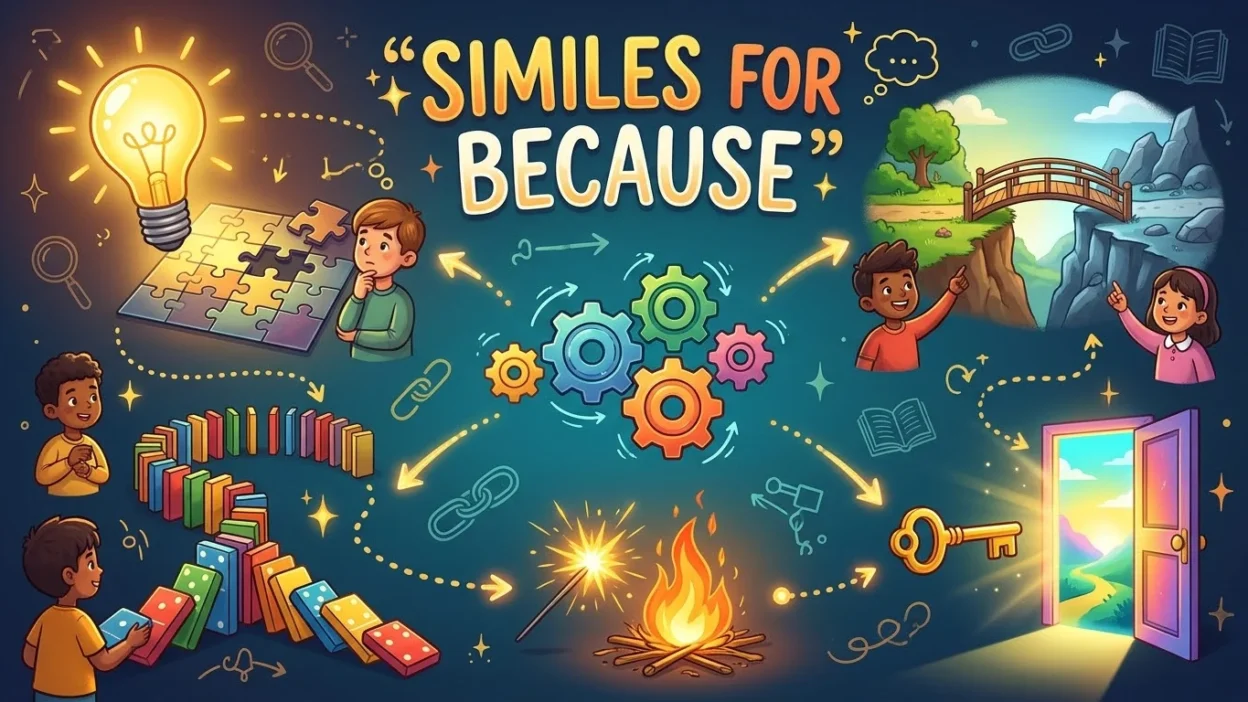
- Like a key opening a locked door — describes how a reason can explain something that was previously unclear.
- As connected as roots and branches — shows how causes and results are linked.
- Like a spark starting a fire — represents one event causing another.
- As clear as sunlight through glass — describes an easy-to-understand explanation.
- Like a missing puzzle piece falling into place — represents discovering the reason behind something.
These comparisons can make explanations more vivid and memorable.
1. Similes for Giving Clear Reasons
- Like a flashlight revealing a hidden path.
- As clear as a window washed by rain.
- Like a map showing the right direction.
- As understandable as a simple picture.
- Like a key opening a locked door.
- As bright as sunlight entering a dark room.
- Like a sign pointing toward the answer.
- As straightforward as a straight road.
- Like a book explaining a mystery.
- As obvious as footprints in fresh snow.
- Like a teacher drawing a helpful diagram.
- As easy to follow as a marked trail.
- Like a candle lighting a quiet room.
- As clear as a bell ringing at noon.
- Like a puzzle revealing its final piece.
2. Similes for Cause and Effect
- Like a spark starting a fire.
- As connected as dominoes falling in a row.
- Like a stone creating ripples in a pond.
- As natural as clouds bringing rain.
- Like a seed growing into a tree.
- As linked as thunder and lightning.
- Like a match lighting a candle.
- As connected as roots and branches.
- Like one gear turning another.
- As predictable as sunrise following night.
- Like a small leak filling a bucket.
- As related as footsteps and a journey.
- Like a snowball growing as it rolls downhill.
- As connected as a river and its stream.
- Like a button starting a machine.
3. Similes for Explaining Why Something Happened
- Like a detective uncovering a hidden clue.
- As revealing as opening a mystery box.
- Like a curtain lifting from a stage.
- As helpful as a guide explaining a route.
- Like a light switching on in a dark room.
- As satisfying as finding a missing puzzle piece.
- Like a story finally making sense.
- As revealing as footprints leading to a door.
- Like a window opening onto a new view.
- As clear as a photograph of the event.
- Like a teacher explaining a difficult lesson.
- As useful as a compass in unfamiliar territory.
- Like a hidden answer appearing in a book.
- As illuminating as a lantern in a cave.
- Like a trail leading directly to its source.
4. Similes for Strong Reasons
- As solid as a rock beneath your feet.
- Like an anchor holding a ship steady.
- As strong as a bridge built from steel.
- Like a mountain standing against the wind.
- As convincing as clear evidence.
- Like a foundation supporting a tall building.
- As dependable as the ground beneath your feet.
- Like a shield protecting a valuable treasure.
- As firm as an oak tree’s roots.
- Like a lock securing a heavy door.
- As powerful as a river carving through stone.
- Like a pillar holding up a roof.
- As steady as a lighthouse in a storm.
- Like a chain with every link connected.
- As convincing as a perfectly completed argument.
5. Similes for Simple Explanations
- As simple as opening a book.
- Like following a well-marked path.
- As easy as counting to three.
- Like a picture explaining a thousand words.
- As clear as a blue sky.
- Like connecting two matching puzzle pieces.
- As straightforward as a road without turns.
- Like reading a familiar story.
- As easy to understand as a child’s drawing.
- Like following instructions one step at a time.
- As simple as switching on a light.
- Like a recipe with clear directions.
- As familiar as your own reflection.
- Like a door opening with one gentle push.
- As uncomplicated as a single straight line.
6. Similes for Hidden Reasons
- Like a secret beneath a closed book.
- As hidden as a pearl inside an oyster.
- Like roots buried beneath the soil.
- As mysterious as a shadow in the forest.
- Like a clue concealed in an old letter.
- As difficult to find as a needle in a haystack.
- Like a locked chest waiting for a key.
- As quiet as a secret whispered at night.
- Like a star hidden behind clouds.
- As buried as treasure beneath the sand.
- Like a message written in invisible ink.
- As mysterious as a winding cave.
- Like a missing page in a diary.
- As concealed as a seed beneath the earth.
- Like a hidden door behind a bookshelf.
7. Similes for Logical Reasons
- As logical as two plus two equals four.
- Like pieces of a mathematical equation.
- As consistent as a clock ticking.
- Like a well-planned chess strategy.
- As orderly as books arranged on a shelf.
- Like a chain with every link in place.
- As balanced as a perfectly working scale.
- Like a formula with the correct values.
- As reasonable as following a clear map.
- Like a bridge connecting two ideas.
- As structured as a carefully written plan.
- Like a puzzle solved step by step.
- As dependable as a tested method.
- Like a straight line connecting two points.
- As sensible as carrying an umbrella before rain.
8. Similes for Emotional Reasons
- Like a heart following its feelings.
- As comforting as a warm blanket.
- Like sunshine breaking through dark clouds.
- As gentle as a breeze on a summer evening.
- Like tears falling after a difficult day.
- As powerful as a mother’s embrace.
- Like a song bringing back old memories.
- As soothing as rain on a quiet roof.
- Like a smile brightening a gloomy morning.
- As warm as a fireplace in winter.
- Like a friend offering a helping hand.
- As deep as an ocean of memories.
- Like a candle glowing in the darkness.
- As tender as a flower opening in spring.
- Like a familiar voice bringing comfort.
9. Similes for Everyday Reasons
- Like an alarm waking someone from sleep.
- As useful as an umbrella on a rainy day.
- Like a key starting a car.
- As familiar as breakfast in the morning.
- Like a phone ringing during a conversation.
- As necessary as water for a thirsty plant.
- Like shoes protecting feet on a long walk.
- As helpful as a map during a journey.
- Like a light guiding someone through a hallway.
- As refreshing as a cool drink after exercise.
- Like a coat protecting someone from winter cold.
- As natural as brushing your teeth every morning.
- Like a clock reminding you of an appointment.
- As important as food for a growing child.
- Like a charger bringing a phone back to life.
10. Similes for Important Reasons
- As important as a foundation beneath a house.
- Like a compass guiding a traveler.
- As valuable as water in a desert.
- Like a lighthouse guiding ships through darkness.
- As essential as oxygen for breathing.
- Like a bridge connecting distant places.
- As necessary as roots for a growing tree.
- Like a key opening an important door.
- As precious as a drop of water in a drought.
- Like a heartbeat keeping a body alive.
- As vital as sunlight for growing plants.
- Like a strong rope holding a climbing traveler.
- As meaningful as the final piece of a puzzle.
- Like a map guiding an explorer home.
- As necessary as wheels for a moving bicycle.
11. Similes for Unexpected Reasons
- Like a sudden storm on a sunny day.
- As surprising as finding a rainbow after rain.
- Like a hidden door opening in an old wall.
- As unexpected as snow in the summer.
- Like a plot twist in a mystery novel.
- As startling as a firework in a quiet sky.
- Like a stranger becoming a close friend.
- As sudden as a flash of lightning.
- Like a forgotten letter appearing in a drawer.
- As surprising as a flower blooming in winter.
- Like a coin appearing beneath a sofa.
- As unexpected as a familiar face in a distant city.
- Like a bird appearing at an open window.
- As sudden as a light turning on.
- Like a new road appearing around a bend.
12. Similes for Scientific Reasons
- Like gravity pulling an apple toward the ground.
- As predictable as water freezing in cold temperatures.
- Like sunlight helping a plant grow.
- As connected as the moon and ocean tides.
- Like electricity flowing through a wire.
- As natural as evaporation under the warm sun.
- Like a magnet attracting iron.
- As essential as oxygen in the air.
- Like heat spreading through a metal spoon.
- As measurable as water filling a container.
- Like a seed responding to sunlight and water.
- As systematic as planets orbiting the sun.
- Like a chemical reaction changing two substances.
- As connected as energy and motion.
- Like rain filling a river over time.
13. Similes for School and Learning Reasons
- Like a teacher opening a new chapter.
- As helpful as a dictionary for learning words.
- Like a pencil making ideas visible.
- As clear as a diagram on a classroom board.
- Like a book unlocking a new world.
- As useful as a calculator during mathematics.
- Like a lesson connecting old knowledge to new ideas.
- As organized as notes in a notebook.
- Like a library opening doors to knowledge.
- As bright as a student’s moment of understanding.
- Like a question leading to an answer.
- As valuable as feedback after a test.
- Like a map guiding a learner through a subject.
- As rewarding as solving a difficult problem.
- Like a teacher turning confusion into understanding.
14. Similes for Convincing Explanations
- As convincing as a photograph showing the truth.
- Like evidence fitting into a clear argument.
- As strong as a bridge made of steel.
- Like a witness describing exactly what happened.
- As clear as a glass window.
- Like a puzzle with every piece accounted for.
- As persuasive as a well-told story.
- Like a spotlight revealing the important details.
- As reliable as a carefully checked result.
- Like a book supporting every statement with facts.
- As solid as a stone wall.
- Like a compass pointing in one direction.
- As complete as a report with every detail.
- Like a clear path through a confusing forest.
- As believable as something seen with your own eyes.
15. Similes for Reasons and Connections in Writing
- Like a thread connecting two pieces of fabric.
- As smooth as a river flowing downstream.
- Like a bridge joining two distant shores.
- As connected as chapters in the same book.
- Like a sentence leading naturally to another.
- As balanced as two sides of a scale.
- Like a road linking two towns.
- As clear as a conversation between close friends.
- Like a chain connecting separate ideas.
- As organized as paragraphs in a well-written essay.
- Like a story unfolding one page at a time.
- As natural as a conversation flowing between friends.
- Like a path connecting two gardens.
- As fitting as the final line of a poem.
- Like a ribbon tying two gifts together.
Simile Sentences for Because
Here are 15 complete sentences showing how comparisons can make explanations more descriptive.
- The rain was like a gentle reminder that the garden needed water.
- His explanation was as clear as sunlight through a glass window.
- The small spark started a fire like a single idea starting a big project.
- Her decision was like a key opening a door to new opportunities.
- The two events were connected like dominoes falling in a row.
- The teacher explained the problem as simply as someone drawing a picture.
- The hidden reason was like a missing puzzle piece finally appearing.
- Their friendship was as strong as roots holding a large tree.
- The evidence was as convincing as a photograph showing the truth.
- The small mistake spread like ripples across a pond.
- His curiosity was like a flashlight revealing hidden details.
- The explanation connected the ideas like a bridge joining two shores.
- The warning was as useful as an umbrella before a storm.
- Her kindness was like sunshine warming a cold morning.
- The final clue appeared like a light switching on in a dark room.
How to Use Similes for Because in Writing
When explaining reasons, you can use similes to make your writing more colorful and easier to understand. Remember that the simile adds imagery, while the word because still introduces the actual reason.
- In stories: “He hurried home because the storm was approaching like a dark curtain across the sky.”
- In school essays: “Plants need sunlight because it acts like energy for their growth.”
- In poetry: “She remembered him because his voice was like a familiar song.”
- In everyday writing: “I carried an umbrella because the clouds looked like heavy gray blankets.”
- In explanations: “The road became slippery because the rain spread like a thin sheet of glass.”
Use comparisons that make the reason easier to imagine rather than making the sentence unnecessarily complicated.
How to Create Your Own Similes for Because
You can create original comparisons by following a few simple steps:
- Identify the reason: Decide what caused an event or explains a situation.
- Choose an image: Think of something that represents the cause or its result.
- Connect the ideas: Use like or as to form your comparison.
- Keep it relevant: Make sure the comparison supports the meaning.
- Read it aloud: Check that the sentence sounds natural.
For example, if you are explaining why a plant grows, you could write: “The plant grew because sunlight fed it like a gentle source of energy.”
If you are explaining why someone felt happy, you might write: “She smiled because the good news arrived like sunshine after a storm.”
Why Use Similes When Explaining Reasons?
Similes can improve explanations by making abstract ideas easier to picture.
- They make ideas clearer: Comparisons can help readers understand difficult concepts.
- They add creativity: Everyday explanations become more interesting.
- They improve storytelling: Figurative language gives scenes more emotion and personality.
- They strengthen communication: A vivid comparison can make a point easier to remember.
- They expand vocabulary: Practicing similes introduces new descriptive expressions.
- They support learning: Students can better understand how figurative language works.
Common Words Related to Because
These words and phrases can help you express reasons and explanations in different ways:
- Since: Introduces a reason or cause.
- As: Can introduce a reason in a sentence.
- Therefore: Shows a result or conclusion.
- Consequently: Introduces an outcome.
- Due to: Explains the cause of something.
- Owing to: Gives a reason for an event.
- Because of: Introduces the cause of a situation.
- For: Can introduce an explanation in formal or literary writing.
- Thus: Shows a logical result.
- So: Connects a reason with its result.
- Reason: An explanation for an action or event.
- Cause: Something that makes an event happen.
- Effect: The result of a cause.
- Explanation: Information that makes something understandable.
- Purpose: The reason something is done.
Practical Exercise: Test Your Simile Skills
Complete these questions to check your understanding.
- A simile usually compares two things using which words?
- Complete this comparison: “Like a spark starting a ______.”
- What does “as clear as sunlight through glass” describe?
- Which image best represents a strong reason: a paper feather, a solid rock, or a floating bubble?
- Complete this sentence: “The two events were connected like ______ falling in a row.”
- What does “like a missing puzzle piece falling into place” suggest?
- Create a simile to describe a clear explanation.
- Which word introduces a reason: because, however, or although?
- Complete this sentence: “The small action spread like ______ across a pond.”
- Write your own sentence using because and a creative simile.
Answers With Explanations
- Like and as. These are the most common words used to form similes.
- Fire. A spark can cause a fire, representing how one event can lead to another.
- Clarity. The comparison describes something easy to understand.
- A solid rock. It represents strength and stability.
- Dominoes. One falling domino can cause the next to fall.
- Discovering an explanation. It suggests that something confusing has finally become understandable.
- Example: “The explanation was as clear as a cloudless sky.” This comparison communicates clarity.
- Because. It introduces the reason for an action or situation.
- Ripples. Ripples spread outward from a small disturbance.
- Answers will vary. Example: “I stayed inside because the rain fell like silver curtains from the sky.” This sentence combines a reason with a creative comparison.
Conclusion
Similes can make explanations about causes, reasons, and connections more vivid and memorable. Although because is a conjunction rather than a descriptive word, comparisons can help you communicate the ideas that follow it. You can describe a cause like a spark starting a fire, an explanation like a light revealing a hidden path, or a connection like two pieces of a puzzle fitting together.
Whether you are writing a school assignment, creating a story, or improving your everyday English, these comparisons can help you express your thoughts with greater creativity. Practice combining clear reasons with meaningful imagery, and your writing will become more engaging and expressive.
Which comparison did you find most useful? Try creating your own and use it in your next writing assignment!
Frequently Asked Questions
1. Can you use a simile for the word because?
Not in the usual sense. Because is a conjunction that introduces a reason. However, similes can be used to make the reason or its explanation more descriptive.
2. What is a creative way to explain because?
You can use comparisons such as “like a key opening a locked door” to describe how a reason helps someone understand something.
3. What is a simile for cause and effect?
“Like a spark starting a fire” is a useful simile for cause and effect because it shows how one small event can lead to a larger result.
4. What is the difference between because and a simile?
Because is a conjunction used to introduce a reason, while a simile is a figure of speech that compares two different things using like or as.
5. Can students use similes with because in sentences?
Yes! For example: “I stayed indoors because the rain fell like a waterfall.” The word because gives the reason, while the simile makes the description more vivid

Ivan Petrov is a fictional Russian language enthusiast and cultural writer who has a deep passion for literature, folklore, and traditional expressions. Growing up in Saint Petersburg, he developed a strong interest in the history of the Russian language and the stories behind its idioms. Ivan enjoys researching the origins of popular sayings and explaining their meanings in a way that is easy for international readers to understand. His educational articles focus on making complex language concepts simple and engaging. He believes that idioms are an important part of preserving cultural heritage and helping people communicate more naturally. Through his work, Ivan encourages readers to appreciate the richness of Russian culture and language while making learning both enjoyable and practical.