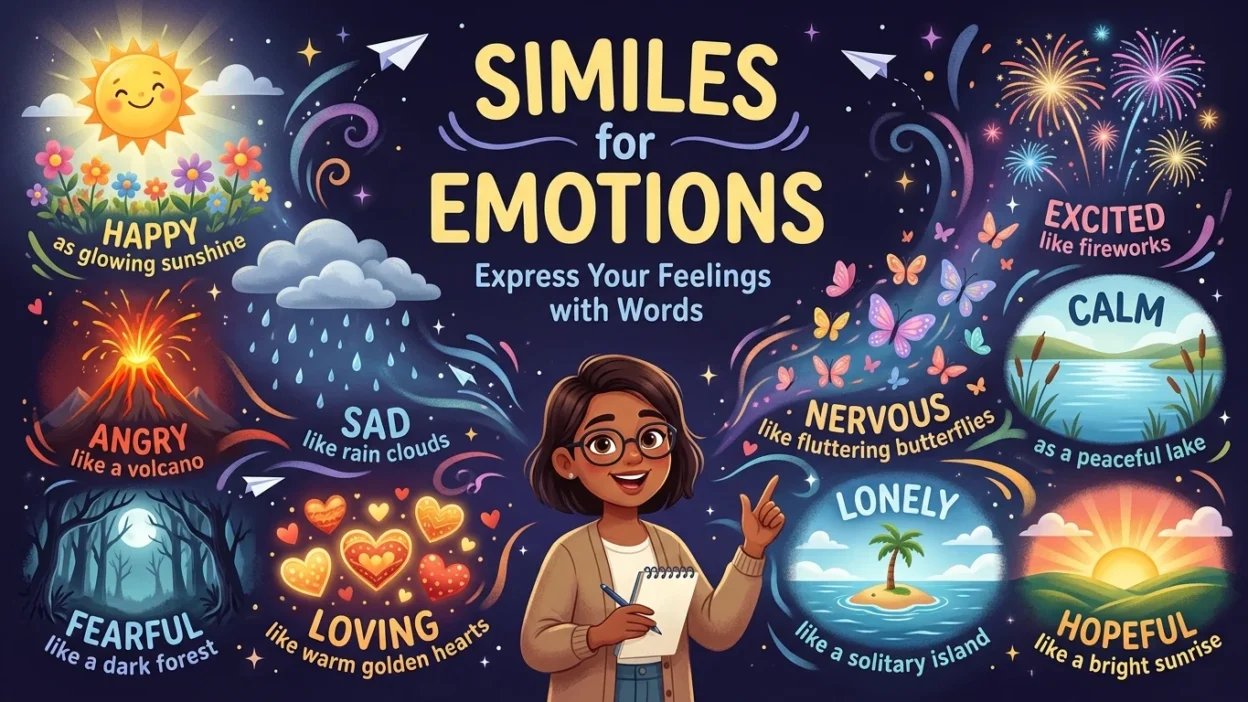
Emotions are a big part of everyday life. We feel happy, sad, angry, excited, nervous, peaceful, and many other feelings. Sometimes, however, ordinary words are not enough to explain exactly how we feel. That is where similes come in!
Similes for emotions compare feelings to familiar things using words such as “like” or “as.” They help readers picture emotions, understand characters, and connect with a story on a deeper level. For example, saying “her happiness was like sunshine after rain” creates a brighter picture than simply saying “she was happy.”
Whether you are a student working on a writing assignment, a teacher preparing a lesson, or a writer looking for fresh ideas, these emotional similes can help you express feelings more clearly. You will discover comparisons for happiness, sadness, anger, fear, love, excitement, loneliness, and many more emotions.
Let’s explore these creative similes and learn how to use them in everyday writing!
What Is a Simile for Emotions?
A simile for emotions is a figure of speech that compares a feeling to something familiar. It helps readers imagine what an emotion feels like instead of simply naming it.
For example:
- Happiness is like sunshine. This comparison suggests warmth and joy.
- Fear spread through him like cold water. This shows how suddenly fear can appear.
- Her anger was as hot as a burning fire. This describes intense frustration.
- Loneliness felt like an empty room. This suggests isolation and sadness.
- Love was like a warm blanket. This creates a feeling of comfort and safety.
Similes make emotional descriptions more vivid, memorable, and meaningful.
1. Similes for Happiness
Happiness can feel bright, warm, and full of energy. These similes describe joyful moments and cheerful feelings.
- As happy as a child on Christmas morning — full of excitement and delight.
- Happiness spread like sunshine — joy reaching every part of a person’s life.
- As cheerful as a bird in spring — lighthearted and full of life.
- As joyful as a rainbow after rain — happy after a difficult time.
- Like a balloon floating into the sky — feeling free and carefree.
- As bright as a summer morning — full of positive energy.
- Like music dancing through the air — happiness that feels lively.
- As delighted as a puppy with a new toy — excited about something wonderful.
- Like flowers opening to the sun — becoming happier and more hopeful.
- As pleased as a winner holding a trophy — proud and satisfied.
- Like bubbles rising in a glass — happiness bubbling up inside.
- As light as a feather in the breeze — feeling carefree.
- Like a garden bursting into bloom — growing more joyful.
- As sweet as honey on a warm day — deeply pleasant and comforting.
- Like stars sparkling in the night — showing little moments of joy.
2. Similes for Sadness
Sadness can feel heavy, quiet, or overwhelming. These comparisons help express grief, disappointment, and emotional pain.
- As sad as a rainy afternoon — feeling gloomy and down.
- Like a cloud covering the sun — happiness hidden by sadness.
- As heavy as a stone in the heart — carrying deep emotional pain.
- Like a wilted flower without water — feeling drained and unhappy.
- As lonely as a bird without its flock — missing companionship.
- Like rain falling on an empty street — quiet and sorrowful.
- As gray as a winter sky — feeling gloomy.
- Like a song played in a minor key — expressing sorrow.
- As fragile as thin glass — emotionally sensitive.
- Like a candle fading in the wind — slowly losing hope.
- As quiet as a house after goodbye — feeling the absence of someone.
- Like waves washing away footprints — watching memories fade or change.
- As cold as an abandoned fireplace — feeling emotionally empty.
- Like a book with its final page missing — feeling that something important is unfinished.
- As deep as the ocean at midnight — experiencing profound sadness.
3. Similes for Anger
Anger can rise quickly, burn intensely, or simmer beneath the surface. These similes describe different levels of frustration.
- As angry as a bull in a storm — fiercely upset.
- Like a volcano ready to erupt — holding back intense anger.
- As hot as a burning stove — feeling furious.
- Like thunder shaking the sky — expressing powerful anger.
- As fierce as a wild tiger — feeling aggressive and intense.
- Like a kettle about to whistle — becoming increasingly irritated.
- As red as a stop sign — showing visible frustration.
- Like a fire spreading through dry grass — anger growing rapidly.
- As sharp as a thorn — speaking with irritation.
- Like a storm trapped inside a bottle — trying to contain anger.
- As explosive as a firecracker — reacting suddenly.
- Like boiling water in a closed pot — letting frustration build.
- As fierce as a blazing furnace — feeling extremely angry.
- Like a drum pounding in a silent room — anger becoming impossible to ignore.
- As prickly as a cactus — acting defensive or irritable.
4. Similes for Fear
Fear can make the heart race, the body freeze, and the mind imagine danger. These similes help describe frightening experiences.
- As scared as a rabbit in headlights — feeling startled and helpless.
- Like ice running through my veins — feeling suddenly frightened.
- As nervous as a cat near water — feeling uneasy.
- Like a shadow following me — feeling that danger is always nearby.
- As frightened as a child in a dark room — feeling vulnerable.
- Like thunder inside my chest — experiencing a racing heartbeat.
- As shaky as a leaf in the wind — trembling with fear.
- Like walking on thin ice — feeling unsafe.
- As pale as a ghost — looking frightened.
- Like a mouse hiding from a hawk — feeling small and threatened.
- As tense as a stretched rubber band — waiting anxiously for something to happen.
- Like footsteps echoing in an empty hallway — feeling uneasy in a frightening setting.
- As silent as a held breath — becoming quiet because of fear.
- Like a storm gathering overhead — sensing that something frightening may happen.
- As trapped as a bird in a cage — feeling unable to escape.
5. Similes for Love
Love can feel warm, safe, exciting, and deeply meaningful. These similes express affection and emotional connection.
- Like sunshine on a cold morning — bringing warmth and comfort.
- As gentle as a mother’s hug — expressing tenderness.
- Like a candle glowing in the dark — providing hope and comfort.
- As warm as a freshly baked loaf of bread — creating a welcoming feeling.
- Like roots holding a tree firmly in the ground — representing a strong connection.
- As sweet as a ripe strawberry — expressing affection and delight.
- Like a river flowing toward the sea — suggesting a natural, steady bond.
- As steady as a lighthouse beam — offering dependable support.
- Like two stars sharing the same sky — feeling connected despite distance.
- As precious as a hidden treasure — valuing someone deeply.
- Like a soft blanket on a winter night — feeling safe and cared for.
- As bright as a heart-shaped lantern — expressing warm affection.
- Like a melody that stays in your mind — remembering someone fondly.
- As deep as an ancient forest — suggesting lasting affection.
- Like a bridge connecting two shores — bringing people closer together.
6. Similes for Excitement
Excitement makes ordinary moments feel extraordinary. It can bring energy, anticipation, and a rush of happiness.
- As excited as a child at a theme park — eagerly anticipating fun.
- Like fireworks bursting in the sky — showing sudden joy and energy.
- As energetic as a puppy at playtime — full of enthusiasm.
- Like a rocket ready for launch — eager to get started.
- As lively as a carnival — buzzing with activity.
- Like popcorn popping in a pan — filled with restless energy.
- As bright as a shooting star — shining with enthusiasm.
- Like a racehorse waiting at the starting line — ready for action.
- As bouncy as a ball on a trampoline — unable to stay still.
- Like a drumroll before a surprise — building anticipation.
- As sparkling as a freshly opened gift — full of delight.
- Like waves racing toward the shore — moving with powerful energy.
- As eager as a traveler at the airport — looking forward to an adventure.
- Like a song reaching its chorus — building toward a thrilling moment.
- As electric as a stadium before a big game — filled with excitement.
7. Similes for Nervousness
Nervousness often appears before a test, a speech, or an important conversation. These similes describe worry and uncertainty.
- As nervous as a student before an exam — worried about the outcome.
- Like butterflies fluttering in my stomach — feeling anxious and excited.
- As shaky as a bridge in a strong wind — feeling uncertain.
- Like a clock ticking too loudly — becoming aware of every passing second.
- As tense as a violin string — feeling emotionally tight.
- Like a rabbit listening for footsteps — staying alert and worried.
- As restless as waves before a storm — unable to settle down.
- Like a leaf trembling on a branch — feeling fragile and uneasy.
- As jumpy as popcorn in a hot pan — reacting to every little sound.
- Like a phone waiting for an important call — anxiously anticipating news.
- As uncertain as a path in thick fog — not knowing what will happen.
- Like a knot tightening in a rope — feeling growing tension.
- As fidgety as a child waiting for a turn — struggling to stay still.
- Like a bird fluttering in a small cage — feeling trapped by worry.
- As restless as a train waiting at the platform — eager for uncertainty to end.
8. Similes for Calmness
Calmness is a peaceful feeling that helps people think clearly and relax. These comparisons create a soothing mood.
- As calm as a still lake — completely peaceful.
- Like a breeze through an open window — gentle and refreshing.
- As peaceful as a sleeping village — quiet and relaxed.
- Like a candle burning without a flicker — steady and composed.
- As smooth as glassy water — free from disturbance.
- Like clouds drifting across the sky — relaxed and unhurried.
- As quiet as fresh snow — creating a sense of stillness.
- Like a cat curled beside a warm fire — comfortable and at ease.
- As steady as a mountain — remaining composed under pressure.
- Like soft music in the background — gently soothing.
- As gentle as falling snowflakes — peaceful and delicate.
- Like a boat resting in a sheltered harbor — safe and secure.
- As relaxed as a Sunday morning — free from pressure.
- Like a garden after the rain — refreshed and tranquil.
- As balanced as a stone resting on the ground — feeling centered.
9. Similes for Loneliness
Loneliness can feel like being separated from others, even when people are nearby. These similes help describe isolation and longing.
- As lonely as a lighthouse on a distant shore — standing apart from others.
- Like a single star in a cloudy sky — feeling isolated.
- As empty as an abandoned house — missing connection.
- Like a chair waiting at an empty table — longing for someone’s company.
- As quiet as a deserted street at midnight — experiencing deep silence.
- Like a boat drifting without a harbor — feeling without direction or belonging.
- As distant as a voice across a canyon — feeling separated from others.
- Like a puzzle with a missing piece — sensing that something is absent.
- As cold as a room without sunlight — feeling emotionally distant.
- Like a letter that never reaches its reader — wanting to connect but feeling unheard.
- As isolated as an island in the ocean — feeling far away from everyone.
- Like a song played to an empty room — having no one to share a moment with.
- As forgotten as a book on a dusty shelf — feeling overlooked.
- Like footsteps disappearing in the sand — feeling unnoticed.
- As silent as a phone that never rings — waiting for contact that does not come.
10. Similes for Hope
Hope helps people believe that better days may come. These similes express optimism, courage, and new beginnings.
- Like a sunrise after a long night — suggesting a fresh start.
- As bright as a candle in darkness — keeping optimism alive.
- Like a seed waiting for spring — believing in future growth.
- As steady as a lighthouse in a storm — holding on through difficulties.
- Like a rainbow after heavy rain — finding beauty after hardship.
- As promising as the first flower of spring — welcoming new possibilities.
- Like a door opening into sunlight — discovering a new opportunity.
- As strong as a tree growing through a crack — continuing despite obstacles.
- Like a star guiding a traveler — finding direction.
- As fresh as morning dew — feeling renewed.
- Like a bridge stretching across a river — believing a way forward exists.
- As warm as the first sunny day after winter — feeling encouraged.
- Like a kite rising against the wind — growing stronger through challenges.
- As alive as a garden after rain — feeling renewed optimism.
- Like a small flame refusing to go out — protecting even a little hope.
11. Similes for Disappointment
Disappointment appears when reality does not match our expectations. These similes help express that letdown.
- Like a balloon losing its air — excitement slowly disappearing.
- As flat as a deflated tire — feeling let down.
- Like rain on a planned picnic — having a happy plan interrupted.
- As bitter as an unripe lemon — feeling unpleasantly disappointed.
- Like a gift box with nothing inside — expecting something that never arrives.
- As dull as a cloudy afternoon — feeling less enthusiastic.
- Like a door closing just before you arrive — narrowly missing an opportunity.
- As heavy as wet clothes — carrying a discouraging feeling.
- Like a song stopping before the final note — feeling that something is incomplete.
- As empty as a theater after the show — experiencing a sudden loss of excitement.
- Like a kite falling from the sky — watching expectations collapse.
- As cold as yesterday’s tea — feeling that the moment has lost its appeal.
- Like a road ending in a wall — discovering that progress is blocked.
- As faded as an old photograph — watching excitement lose its color.
- Like a wave retreating from the shore — feeling that a promising moment has passed.
12. Similes for Pride
Pride can come from achieving a goal, helping someone, or becoming better at something. These similes describe satisfaction and confidence.
- As proud as a parent at graduation — feeling deeply pleased.
- Like a trophy shining under bright lights — celebrating achievement.
- As tall as a mountain — feeling confident and strong.
- Like a flag flying at the top of a hill — showing accomplishment.
- As bright as a medal on a uniform — displaying success.
- Like a sunflower turning toward the sun — standing tall with confidence.
- As steady as an oak tree — feeling secure in one’s abilities.
- Like a runner crossing the finish line — celebrating a personal victory.
- As golden as a summer sunset — feeling warmly satisfied.
- Like a freshly polished mirror — feeling pleased with one’s efforts.
- As strong as a bridge that holds its weight — trusting one’s capabilities.
- Like a mountain climber reaching the summit — enjoying a hard-earned success.
- As brilliant as a star on a clear night — feeling recognized.
- Like a garden full of blooming flowers — seeing the results of hard work.
- As satisfied as a chef serving a perfect meal — feeling proud of a job well done.
13. Similes for Embarrassment
Embarrassment can make someone blush, become quiet, or wish to disappear for a moment. These similes capture awkward feelings.
- As red as a tomato — blushing from embarrassment.
- Like a spotlight suddenly turning on — feeling that everyone’s attention is focused on you.
- As awkward as a penguin on roller skates — feeling uncomfortable in a situation.
- Like a turtle hiding in its shell — wanting to avoid attention.
- As hot as a summer sidewalk — feeling your face grow warm.
- Like a balloon slowly sinking — losing confidence in public.
- As quiet as a mouse in a library — trying not to be noticed.
- Like a shoe on the wrong foot — feeling out of place.
- As flustered as a waiter carrying too many plates — struggling to manage an awkward moment.
- Like a page with a giant ink stain — feeling that a mistake is obvious.
- As uncomfortable as a sweater in hot weather — wishing the situation would end.
- Like a comedian forgetting the punchline — feeling awkward in front of others.
- As exposed as a book left open on a table — feeling that a mistake is visible.
- Like a bird startled from a branch — reacting suddenly to attention.
- As tangled as headphones in a pocket — feeling confused and awkward.
14. Similes for Relief
Relief comes when worry fades or a difficult situation finally ends. These similes express comfort and release.
- Like a heavy backpack being set down — no longer carrying a burden.
- As refreshing as cool water on a hot day — feeling instantly better.
- Like a storm clearing from the sky — watching worry disappear.
- As light as air after a long sigh — feeling free from pressure.
- Like reaching shore after a rough swim — finding safety after difficulty.
- As soothing as a warm bath — feeling comforted.
- Like a locked door finally opening — escaping a stressful situation.
- As peaceful as rain stopping at dawn — enjoying the end of tension.
- Like taking off tight shoes — experiencing welcome comfort.
- As welcome as shade on a scorching afternoon — finding a break from pressure.
- Like an alarm clock finally going silent — ending an anxious wait.
- As sweet as the first sip of water when thirsty — experiencing satisfying comfort.
- Like a knot coming loose — feeling tension release.
- As free as a bird leaving its cage — escaping a restriction.
- Like sunlight returning after an eclipse — feeling hope and ease return.
15. Similes for Mixed Emotions
Sometimes we feel several emotions at once. A special moment can be joyful and sad, exciting and frightening, or comforting and painful.
- Like sunshine breaking through rain — feeling happy despite sadness.
- As tangled as a ball of yarn — experiencing confusing feelings.
- Like a roller coaster climbing and falling — moving between excitement and fear.
- As changeable as the weather in spring — feeling different emotions quickly.
- Like sweet and sour candy — experiencing pleasure and discomfort together.
- As restless as the sea before a storm — feeling uncertain and excited.
- Like a rainbow with dark clouds behind it — feeling hope mixed with worry.
- As complicated as a maze — struggling to understand your feelings.
- Like two songs playing at once — experiencing emotions that compete.
- As bright and dark as a moonlit forest — feeling comfort and fear together.
- Like a book with happy and sad chapters — experiencing different emotional moments.
- As unpredictable as a spinning coin — not knowing which feeling will take over.
- Like a flower growing through a crack in concrete — finding happiness in hardship.
- As delicate as a bubble in the wind — feeling joy mixed with uncertainty.
- Like a sunset that is beautiful and bittersweet — appreciating something while feeling sad that it is ending.
Simile Sentences for Emotions
Here are 15 complete sentences showing how emotional similes work in everyday writing.
- When Maya heard the good news, her happiness spread like sunshine across the room.
- After saying goodbye to his best friend, Liam felt as lonely as an island in the ocean.
- His anger was like a volcano ready to erupt, but he took a deep breath.
- I felt as nervous as a student before an exam when the teacher called my name.
- Her love was like a warm blanket on a cold winter night.
- The children were as excited as puppies at playtime before the school trip.
- After the frightening noise, fear ran through me like ice water.
- The lake made me feel as calm as a still pond at sunrise.
- Hope glowed like a small candle in the darkest part of her life.
- His disappointment felt like a balloon losing all its air.
- She stood as proud as a mountain climber who had reached the summit.
- My face turned as red as a tomato when I forgot my lines.
- Relief washed over us like cool water after a long, hot day.
- His emotions were as tangled as headphones left in a pocket.
- She smiled through her tears, like sunshine breaking through rain.
How to Use Similes for Emotions in Writing
Emotional similes can make stories, poems, essays, and personal descriptions more vivid. However, they work best when they match the feeling and the situation.
- Show instead of simply telling: Instead of writing “I was nervous,” try “My thoughts fluttered like birds in a cage.”
- Choose familiar comparisons: Compare emotions to weather, nature, music, light, or everyday experiences.
- Match the mood: Use sunshine for hope, storms for anger, and quiet lakes for calmness.
- Consider your character: A child might describe happiness as being like a puppy at playtime, while an adult might compare it to a peaceful sunrise.
- Avoid overusing similes: One strong comparison can be more effective than several in the same paragraph.
- Make the comparison meaningful: The image should help readers understand the feeling, not distract them from it.
For example, instead of writing “Sara was sad because her friend moved away,” you could write, “Sara’s sadness settled over her like a gray cloud that would not move.” The second sentence creates a clearer emotional picture.
How to Create Your Own Similes for Emotions
Creating original similes is easier when you follow a few simple steps.
- Name the emotion. Decide whether you want to describe joy, fear, anger, love, or another feeling.
- Think about the physical sensation. Does the emotion feel heavy, warm, shaky, light, or tight?
- Choose an image. Think about weather, animals, objects, sounds, colors, or places.
- Connect the two ideas. Use “like” or “as” to build your comparison.
- Check the meaning. Make sure the comparison gives readers the feeling you intended.
For example:
- Emotion: Nervousness
- Sensation: A fluttering stomach
- Image: Birds moving quickly
- Simile: “Nervousness fluttered in my stomach like a flock of startled birds.”
Try creating different versions until you find one that sounds natural and fits your writing style.
Similes for Emotions for Kids
Children can use simple similes to describe how they feel at home, at school, and with friends.
- Happy as a sunny day — feeling cheerful.
- Sad as a rainy cloud — feeling unhappy.
- Angry as a roaring lion — feeling furious.
- Scared as a mouse in a dark room — feeling frightened.
- Excited as a puppy with a ball — feeling eager.
- Calm as a quiet lake — feeling peaceful.
- Nervous as a rabbit in a garden — feeling worried.
- Proud as a winner with a medal — feeling pleased.
- Lonely as a star far away — missing company.
- Hopeful as a seed in spring — believing something good can happen.
Kids can practice by completing sentences such as “I felt as happy as ___” or “My nervousness was like ___.” There is no single correct answer as long as the comparison makes sense.
Why Use Similes for Emotions?
Similes help writers communicate feelings in ways that readers can picture and remember.
- They make writing vivid: Readers can imagine an emotion through a familiar image.
- They improve storytelling: Emotional comparisons help readers understand characters.
- They encourage creativity: Writers can connect feelings with unexpected objects and experiences.
- They make abstract ideas easier to understand: A feeling such as anxiety becomes clearer when compared to a knot tightening.
- They add variety: Similes prevent descriptions from sounding repetitive.
- They help children learn language: Simple comparisons make figurative language easier to understand.
- They build emotional understanding: Describing feelings can help people recognize and communicate what they experience.
The most effective similes are clear, relevant, and suited to the moment. A gentle comparison may work well for love, while a powerful image may be better for anger or fear.
Common Words Related to Emotions
Understanding emotion-related vocabulary can help you choose more precise similes.
- Joy: Happiness, delight, pleasure, cheerfulness.
- Sadness: Sorrow, grief, disappointment, gloom.
- Anger: Rage, frustration, irritation, fury.
- Fear: Anxiety, fright, panic, dread.
- Love: Affection, devotion, tenderness, warmth.
- Excitement: Enthusiasm, anticipation, eagerness, thrill.
- Calmness: Peace, serenity, relaxation, composure.
- Loneliness: Isolation, emptiness, separation, longing.
- Hope: Optimism, confidence, expectation, possibility.
- Pride: Satisfaction, achievement, confidence, accomplishment.
- Embarrassment: Awkwardness, discomfort, self-consciousness.
- Relief: Comfort, reassurance, release, ease.
Using these words alongside similes can help you express emotions more accurately and avoid repeating the same descriptions.
Practical Exercise: Test Your Simile Skills
Complete each sentence by choosing the best simile or writing your own comparison.
- After winning the competition, Mia felt as happy as ______.
- His anger was like a ______ ready to erupt.
- Before the presentation, I felt as nervous as ______.
- The peaceful garden made her feel as calm as ______.
- When her friend moved away, she felt as lonely as ______.
- Hope shone like a ______ in the darkness.
- The children were as excited as ______ before the school trip.
- My face became as red as ______ when I made a mistake.
- After the stressful exam, relief washed over me like ______.
- His mixed emotions were as tangled as ______.
Answers With Explanations
These are sample answers. You can create your own similes if they express the intended emotion clearly.
- A child on Christmas morning. This comparison expresses excitement and happiness.
- A volcano. A volcano suggests anger that has built up and may suddenly erupt.
- A student before an exam. This is a familiar example of nervous anticipation.
- A still lake. Still water creates an image of peace and quiet.
- An island in the ocean. An isolated island represents separation and loneliness.
- A candle. A small flame represents hope during a difficult time.
- Puppies at playtime. This comparison shows lively anticipation.
- A tomato. Tomatoes are often used to describe a bright red blush.
- Cool water on a hot day. This suggests comfort after stress.
- A ball of yarn. Tangled yarn represents feelings that are difficult to sort out.
Conclusion
Similes for emotions help turn ordinary descriptions into vivid and meaningful expressions. Instead of simply saying that someone is happy, angry, nervous, or sad, you can compare that feeling to sunshine, a storm, fluttering birds, or a cloudy sky. These images help readers connect with emotions and understand the experiences behind them.
You can use emotional similes in stories, poems, school assignments, journal entries, and everyday conversations. Start with a feeling, imagine what it reminds you of, and connect the two ideas using “like” or “as.” With practice, you will discover fresh ways to express even complicated emotions.
Which emotional simile is your favorite? Share your own creative comparison and inspire other writers to describe feelings in new ways!
Frequently Asked Questions
1. What is a simile for emotions?
A simile for emotions compares a feeling to something familiar using “like” or “as.” For example, “Her happiness was like sunshine” compares joy to warmth and brightness.
2. What are some common similes for feelings?
Common examples include “as happy as a child on Christmas morning,” “as angry as a bull,” “like butterflies in my stomach,” and “as calm as a still lake.”
3. How do similes help describe emotions?
Similes create mental pictures that help readers understand feelings more clearly. They can make emotional writing more vivid, relatable, and memorable.
4. Can children use similes for emotions?
Yes! Children can use simple comparisons such as “happy as a sunny day,” “sad as a rainy cloud,” and “scared like a mouse in a dark room.”
5. How can I create an original simile for an emotion?
Choose an emotion, think about how it feels, and compare it to an object, animal, sound, or natural event. For example, “My excitement bounced like a ball on a trampoline.”

Ivan Petrov is a fictional Russian language enthusiast and cultural writer who has a deep passion for literature, folklore, and traditional expressions. Growing up in Saint Petersburg, he developed a strong interest in the history of the Russian language and the stories behind its idioms. Ivan enjoys researching the origins of popular sayings and explaining their meanings in a way that is easy for international readers to understand. His educational articles focus on making complex language concepts simple and engaging. He believes that idioms are an important part of preserving cultural heritage and helping people communicate more naturally. Through his work, Ivan encourages readers to appreciate the richness of Russian culture and language while making learning both enjoyable and practical.