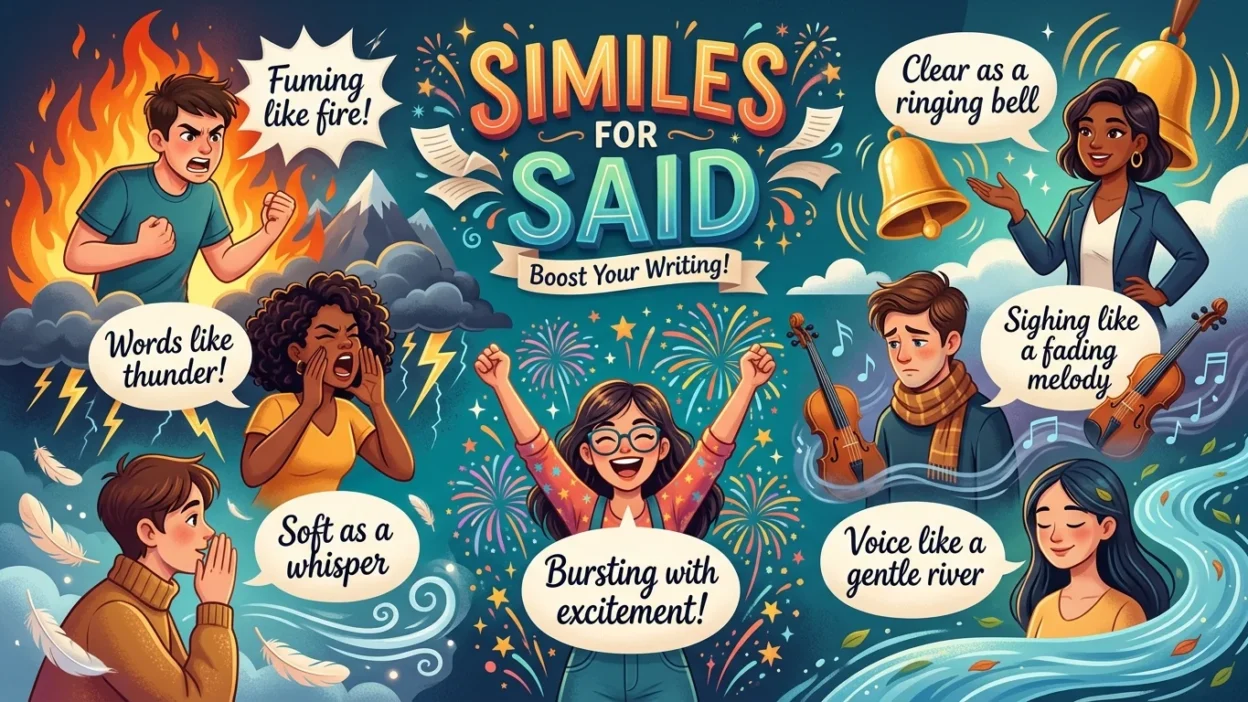
The word “said” is one of the most useful dialogue tags in English. However, writers sometimes want to describe how someone speaks rather than simply tell readers that a character said something. This is where creative comparisons can make dialogue more vivid.
A simile compares one thing to another using words such as “like” or “as.” For example, instead of writing, “He said it loudly,” you might write, “His words burst out like thunder.” The comparison gives the reader a stronger sense of the character’s voice and emotion.
Similes for said can help describe speech that is quiet, loud, angry, excited, nervous, happy, sad, confident, mysterious, or gentle. They are especially useful in stories, novels, poems, scripts, essays, and creative writing.
In this guide, you’ll find creative, poetic, funny, dramatic, simple, and kid-friendly similes related to said and speaking. You’ll also learn how to create your own vivid comparisons without making your writing feel repetitive.
What Is a Simile for Said?
A simile for said compares the way someone speaks to another sound, action, object, or natural phenomenon.
For example:
- His words came out like thunder.
- She spoke as softly as a whisper.
- He said it like a warning bell.
- Her voice flowed like a gentle river.
- His words cracked like a whip.
These descriptions help readers imagine the sound, speed, volume, or emotion behind the dialogue.
1. Similes for Said Loudly
Use these comparisons when a character speaks with a powerful or booming voice.
- His words came out like thunder.
- She spoke like a roaring lion.
- His voice boomed like a cannon.
- He shouted as loudly as a siren.
- Her words burst out like fireworks.
- His voice crashed like a storm.
- She spoke like a trumpet.
- His words echoed like thunder across the hills.
- He called out like a warning bell.
- Her voice rang like a church bell.
- His words exploded like a firework.
- He spoke as loudly as a crashing wave.
- Her voice thundered like a waterfall.
- His shout rolled like distant thunder.
- She called like a horn across the valley.
2. Similes for Said Quietly
Quiet speech can suggest secrecy, fear, sadness, or intimacy.
- She spoke as softly as a whisper.
- His words floated like a feather.
- She spoke like a breeze through leaves.
- His voice was quiet as falling snow.
- She whispered like the wind.
- Her words slipped out like a secret.
- He spoke as softly as rain.
- Her voice drifted like mist.
- His words fell like gentle petals.
- She spoke like a candle flickering in darkness.
- His voice was as quiet as a sleeping room.
- Her words moved like a soft breeze.
- He spoke like a shadow passing by.
- Her voice floated like a cloud.
- His words whispered like leaves in the wind.
3. Similes for Said Angrily
Angry speech can be sharp, loud, and forceful.
- His words cracked like a whip.
- She spoke like thunder.
- His voice burned like fire.
- He shouted like a furious storm.
- Her words struck like lightning.
- His voice roared like a lion.
- She spoke with the force of a hammer.
- His words exploded like fireworks.
- He spoke like a volcano about to erupt.
- Her voice snapped like a breaking branch.
- His words hit like stones.
- She shouted like thunder rolling across the sky.
- His voice was sharp like a knife.
- Her words came out like sparks.
- He spoke as fiercely as a raging fire.
4. Similes for Said Happily
Happy speech often sounds light, warm, and energetic.
- She spoke like a bird singing at sunrise.
- His words bubbled like a sparkling stream.
- She laughed like bells ringing.
- His voice danced like music.
- She spoke as brightly as sunshine.
- His words burst out like colorful confetti.
- She spoke like a cheerful song.
- His voice sparkled like sunlight on water.
- Her words flowed like a happy melody.
- He spoke like a child opening a present.
- Her voice rang like silver bells.
- His words bounced like bright balloons.
- She spoke with the warmth of sunshine.
- His voice danced like a summer breeze.
- Her words floated like cheerful music.
5. Similes for Said Sadly
These comparisons can make sad dialogue feel more emotional.
- She spoke like a fading song.
- His words fell like autumn leaves.
- She spoke as softly as falling rain.
- His voice trembled like a candle flame.
- Her words drifted like smoke.
- He spoke like someone carrying a heavy stone.
- Her voice sounded like a lonely violin.
- His words fell like tears.
- She spoke like a flower bending in the rain.
- His voice was as low as distant thunder.
- Her words faded like sunset light.
- He spoke like a wounded bird.
- Her voice cracked like thin ice.
- His words drifted like lonely clouds.
- She spoke with the softness of falling snow.
6. Similes for Said Nervously
Nervous speech can sound shaky, uncertain, or rushed.
- He spoke like a nervous rabbit.
- Her words tumbled out like falling marbles.
- His voice shook like a leaf in the wind.
- She spoke as nervously as a bird before a storm.
- His words stumbled like someone walking in the dark.
- Her voice trembled like a frightened mouse.
- He spoke like a student before an exam.
- Her words came out like scattered beads.
- His voice wavered like a candle flame.
- She spoke as shakily as a leaf.
- His words rushed like water through a broken pipe.
- Her voice fluttered like a trapped bird.
- He spoke like someone searching for the right words.
- Her words stumbled like stones down a hill.
- His voice quivered like a string under tension.
7. Similes for Said Excitedly
Excited speech can be quick, energetic, and enthusiastic.
- She spoke like fireworks exploding.
- His words raced like a speeding train.
- She talked like a bubbling stream.
- His voice jumped like a spring.
- Her words burst out like confetti.
- He spoke like a child on Christmas morning.
- Her voice sparkled like sunlight.
- His words rushed like a waterfall.
- She spoke like a bird singing after sunrise.
- His voice bounced like a rubber ball.
- Her words flew like colorful birds.
- He talked like someone who had just won a prize.
- Her voice bubbled like soda.
- His words came out like a burst of sunshine.
- She spoke as excitedly as a crowd before a celebration.
8. Similes for Said Calmly
Calm speech can create a peaceful and controlled mood.
- He spoke like a quiet river.
- Her voice flowed like gentle water.
- He spoke as calmly as a still lake.
- Her words drifted like clouds.
- His voice was smooth like polished stone.
- She spoke like a peaceful breeze.
- His words moved like slow waves.
- Her voice settled like falling snow.
- He spoke as peacefully as morning rain.
- Her words flowed like a gentle stream.
- His voice was calm like a quiet forest.
- She spoke like sunlight through leaves.
- His words moved as smoothly as a river.
- Her voice was soft like warm rain.
- He spoke with the calmness of a sleeping sea.
9. Similes for Said Confidently
Confidence can make speech sound firm, clear, and powerful.
- He spoke like a leader addressing a crowd.
- Her voice rang like a clear bell.
- He spoke as firmly as a mountain stands.
- Her words landed like solid stones.
- His voice was strong like an oak tree.
- She spoke like someone who knew the answer.
- His words carried like thunder across a valley.
- Her voice stood firm like a lighthouse.
- He spoke with the certainty of a compass pointing north.
- Her words were sharp like an arrow.
- His voice was steady like a clock.
- She spoke as boldly as a lion.
- His words struck like a hammer.
- Her voice rang with the strength of a bell.
- He spoke like a captain giving orders.
10. Similes for Said in a Whisper
Whispering can suggest secrets, fear, intimacy, or mystery.
- She whispered like a breeze.
- His words slipped out like secrets.
- She spoke as softly as snow falling.
- His voice floated like mist.
- Her whisper moved like smoke.
- He whispered like the wind through trees.
- Her words fell like feathers.
- His voice was quiet as a sleeping child.
- She whispered like a shadow.
- His words drifted like a cloud.
- Her voice was soft as moonlight.
- He whispered like someone afraid to wake the room.
- Her words floated like dust in sunlight.
- His whisper curled through the darkness like smoke.
- She spoke as softly as a falling leaf.
11. Similes for Said Quickly
Fast speech can show excitement, panic, anger, or urgency.
- His words rushed like a waterfall.
- She spoke like a speeding train.
- His sentences flew like arrows.
- Her words tumbled like stones down a hill.
- He talked like a machine.
- Her voice raced like a car.
- His words poured out like rain.
- She spoke as quickly as a hummingbird’s wings moved.
- His voice rushed like a river after a storm.
- Her words came out like bouncing balls.
- He spoke like someone chasing a deadline.
- Her sentences spilled like water from a bucket.
- His words flew like birds startled from a tree.
- She talked like a runaway train.
- His speech raced like lightning.
12. Similes for Said Slowly
Slow speech can suggest sadness, thoughtfulness, tiredness, or seriousness.
- He spoke like a slow-moving river.
- Her words came slowly like falling snow.
- He spoke as slowly as a turtle walks.
- Her voice drifted like a lazy cloud.
- His words stretched like warm taffy.
- She spoke like someone waking from a dream.
- His voice moved like a quiet stream.
- Her words fell one by one like autumn leaves.
- He spoke with the patience of a slow river.
- Her voice floated like mist.
- His words arrived like drops of rain.
- She spoke as slowly as a clock ticking at midnight.
- His sentences moved like clouds across the sky.
- Her words unfolded like flower petals.
- He spoke like a story being told beside a fire.
13. Similes for Said Mysteriously
Mysterious speech can create suspense and curiosity.
- He spoke like a voice from the shadows.
- Her words floated like smoke.
- He spoke as mysteriously as a locked door.
- Her voice whispered like wind through an empty hallway.
- His words hid like secrets.
- She spoke like an old riddle.
- His voice drifted like fog.
- Her words curled like smoke in the air.
- He spoke like someone carrying a secret.
- Her voice was dark like a moonless night.
- His words fell like clues.
- She spoke like a mysterious stranger in a dream.
- His voice echoed like footsteps in an empty room.
- Her words disappeared like mist.
- He spoke with the mystery of a hidden path.
14. Similes for Said With Fear
Fear can make a person’s voice weak, shaky, or uncertain.
- His voice shook like a leaf.
- She spoke like a frightened bird.
- His words trembled like candlelight.
- Her voice cracked like thin ice.
- He spoke as nervously as a rabbit.
- Her words came out like frightened whispers.
- His voice quivered like a string.
- She spoke like someone lost in the dark.
- His words stumbled like footsteps on broken ground.
- Her voice fluttered like a trapped bird.
- He spoke as shakily as a leaf in a storm.
- Her words escaped like startled birds.
- His voice was faint like distant thunder.
- She whispered like someone hiding from danger.
- His words trembled like raindrops on glass.
15. Similes for Said for Kids
These simple comparisons are easy for children to understand and use.
- She spoke like a bird singing.
- He shouted like a lion.
- She whispered like the wind.
- He spoke as softly as a feather falls.
- She talked like a cheerful song.
- He spoke like a roaring bear.
- Her words flowed like a river.
- His voice rang like a bell.
- She spoke like a happy child.
- He shouted like thunder.
- Her voice shook like a leaf.
- He talked like a speeding train.
- She whispered like a secret.
- His words bounced like a ball.
- Her voice was gentle like a breeze.
Simile Sentences for Said
Here are complete sentences you can use in stories and creative writing:
- “I don’t know,” she whispered like a breeze through the trees.
- “Stop!” he shouted like thunder.
- “We won!” she cried like a child opening a present.
- “Please wait,” he said as softly as falling snow.
- “I knew we could do it,” she spoke like a confident leader.
- “Leave me alone!” he snapped like a whip.
- “I’m scared,” she murmured like a frightened bird.
- “Look at this!” he exclaimed like fireworks bursting in the sky.
- “Everything will be fine,” she said as calmly as a still lake.
- “I don’t understand,” he said like someone lost in a fog.
- “Come quickly!” she called like a warning bell.
- “I miss you,” he said like a fading song.
- “Yes, I can,” she answered as firmly as a mountain.
- “Be quiet,” he whispered like a secret slipping through the darkness.
- “We have to go now,” she said like a speeding train rushing forward.
How to Use Similes for Said in Writing
A simile can help you show how dialogue sounds without repeatedly using words such as said, shouted, or whispered.
Instead of:
“I’m scared,” she said.
Try:
“I’m scared,” she whispered like a frightened bird.
Instead of:
“Get out!” he said angrily.
Try:
“Get out!” His words cracked like a whip.
The second examples give the reader a clearer sense of the character’s emotion.
However, you do not need to replace said every time. The word said is often invisible to readers, which makes dialogue easy to follow. Use vivid comparisons when they genuinely add something to the scene.
How to Create Your Own Similes for Said
Creating similes for speech is simple when you focus on the character’s emotion.
Step 1: Identify the Emotion
Ask:
- Is the character angry?
- Happy?
- Sad?
- Nervous?
- Excited?
- Afraid?
- Calm?
- Confident?
- Mysterious?
Step 2: Think About a Matching Sound
For example:
Angry:
- Thunder
- Fire
- A whip
- A roaring animal
Quiet:
- Snow
- Wind
- Rain
- A feather
Excited:
- Fireworks
- Bouncing balls
- Rushing water
- Birds
Sad:
- Falling rain
- A fading song
- A lonely violin
- Autumn leaves
Step 3: Make the Comparison
Use like or as.
His voice roared like thunder.
Or:
Her voice was as soft as falling snow.
Step 4: Keep It Natural
A simile should make the dialogue clearer, not distract from it. Choose comparisons that match the character and scene.
Why Use Similes for Said?
Similes can make dialogue more:
- Vivid
- Emotional
- Descriptive
- Memorable
- Expressive
- Dramatic
- Entertaining
- Natural
Compare:
“I’m leaving,” she said.
with:
“I’m leaving,” she said, her voice cold like winter rain.
The second sentence gives readers an emotional clue about the character.
Similes can also help writers avoid repetitive dialogue descriptions while keeping the focus on the character’s voice and feelings.
Common Words Related to Said
When writing dialogue, these words can help describe different kinds of speech:
- Said
- Spoke
- Whispered
- Shouted
- Yelled
- Cried
- Murmured
- Muttered
- Called
- Exclaimed
- Replied
- Answered
- Asked
- Explained
- Announced
- Declared
- Admitted
- Suggested
- Responded
- Mentioned
Remember that said is not a weak word. It is often the clearest and most natural dialogue tag. Creative descriptions should support the scene rather than overwhelm it.
Practical Exercise: Test Your Simile Skills
Complete each sentence with a suitable comparison.
- She whispered like ________.
- He shouted like ________.
- Her words flowed like ________.
- His voice shook like ________.
- She spoke happily like ________.
- His angry words cracked like ________.
- He spoke calmly like ________.
- Her nervous words tumbled like ________.
- His mysterious voice drifted like ________.
- She spoke confidently like ________.
Answers With Explanations
- A gentle breeze — A breeze suggests something soft and quiet.
- Thunder — Thunder represents a loud and powerful sound.
- A river — A river suggests smooth and continuous movement.
- A leaf in the wind — A trembling leaf represents nervousness or fear.
- A bird singing — Birdsong suggests happiness and energy.
- A whip — A cracking whip suggests sharp, sudden speech.
- A still lake — A still lake represents peace and control.
- Falling marbles — Marbles suggest quick, scattered movement.
- Smoke — Smoke creates a mysterious, drifting image.
- A leader — A leader represents confidence and authority.
Conclusion
Similes for said can make dialogue more vivid by showing the sound, emotion, and energy behind a character’s words. Instead of simply telling readers that someone spoke angrily, sadly, nervously, or happily, you can compare their voice to thunder, a fading song, a trembling leaf, a gentle breeze, or fireworks.
The key is to choose a comparison that fits the emotion and situation. A loud character might speak like thunder, while a quiet character might speak like falling snow.
Remember that said itself is perfectly useful in writing. You do not have to replace it constantly. Instead, use creative similes when they add meaning, atmosphere, or emotion to your scene.
With practice, you can turn ordinary dialogue into writing that feels expressive, natural, and memorable.
FAQs About Similes for Said
1. What is a simile for said?
A simile for said compares the way someone speaks to another sound or action, such as “his words came out like thunder.”
2. What is a simile for said quietly?
You could write “she spoke as softly as falling snow” or “her words floated like a feather.”
3. What is a simile for said angrily?
“His words cracked like a whip” is a strong simile for angry speech.
4. What is a simile for said happily?
You could say “her voice danced like music” to suggest cheerful, energetic speech.
5. Should writers replace the word “said” with similes?
Not always. Said is a useful and natural dialogue tag. Use similes when they add a meaningful description of the character’s voice or emotion.