
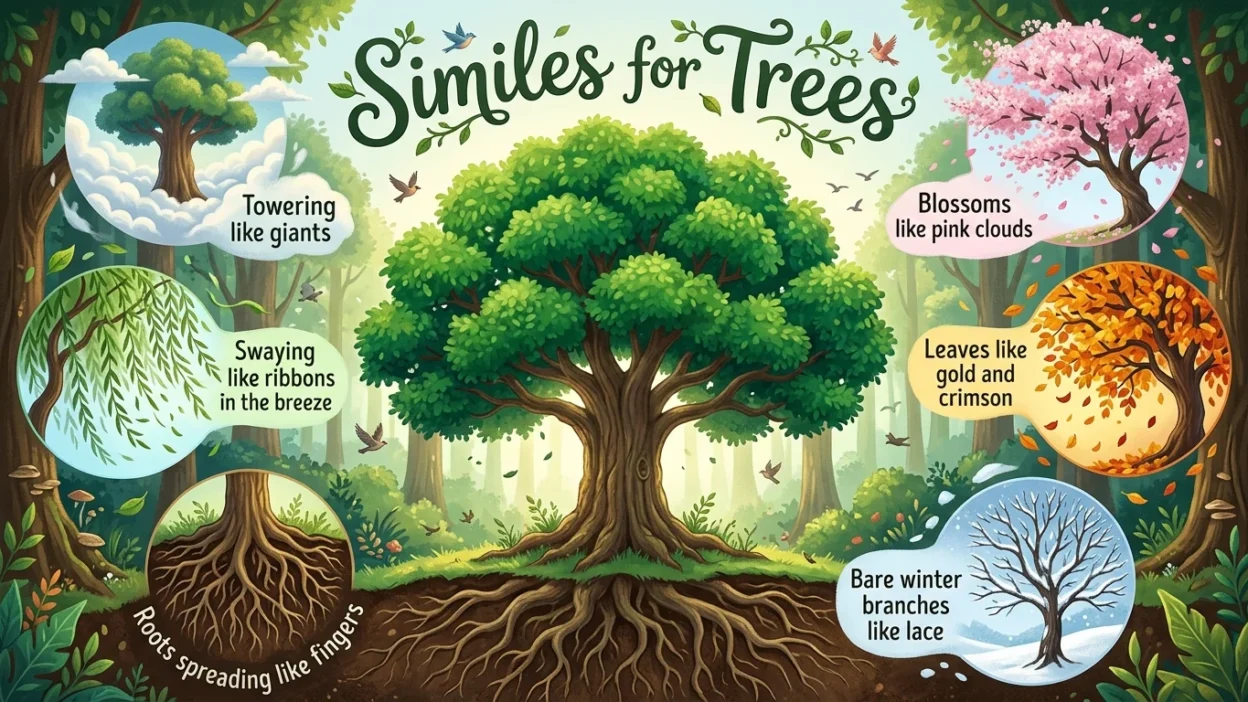
Trees are among nature’s most beautiful creations. They provide shade, shelter wildlife, produce fresh air, and make our surroundings peaceful and colorful. From towering oak trees to delicate cherry blossoms, every tree has something special to offer. But how can we describe their beauty, strength, and movement in a more interesting way? The answer is similes for trees!
Similes compare one thing to another using words such as “like” or “as.” They help readers imagine the appearance, size, texture, and movement of trees. For example, saying “the tree stood as tall as a giant” creates a stronger picture than simply saying “the tree was tall.”
Whether you are a student writing a school assignment, a teacher explaining figurative language, a poet describing nature, or a storyteller creating a magical forest, these similes can inspire your writing. You will find comparisons for tall trees, old trees, leafy branches, autumn trees, trees in winter, and much more.
Let’s explore these creative tree similes and discover how to bring nature to life with words!
What Is a Simile for Trees?
A simile for trees is a figure of speech that compares a tree or one of its features to something familiar. It uses “like” or “as” to make descriptions more vivid.
Here are a few simple examples:
- The tree was as tall as a tower. This emphasizes its great height.
- Its branches spread like open arms. This makes the tree seem welcoming.
- The leaves danced like tiny green butterflies. This describes the movement of leaves in the wind.
- The old tree stood like a wise guardian. This suggests age, strength, and protection.
- The forest was as thick as a green blanket. This describes a dense area filled with trees.
Similes help readers picture trees more clearly and make descriptions of nature more memorable.
1. Similes for Tall Trees
Tall trees can make us feel small beneath their towering branches. These similes highlight their impressive height.
- As tall as a skyscraper — rising high above the ground.
- Like a giant reaching for the sky — stretching upward.
- As high as a castle tower — standing above nearby objects.
- Like a green pillar holding up the heavens — appearing strong and majestic.
- As tall as a mountain’s shadow — suggesting impressive height.
- Like a ladder climbing into the clouds — reaching toward the sky.
- As towering as a cathedral — creating a sense of grandeur.
- Like a giant standing among children — appearing much taller than its surroundings.
- As high as a flagpole — rising straight upward.
- Like an arrow pointing toward the clouds — emphasizing its upright shape.
- As majestic as a palace column — standing proudly.
- Like a green giant guarding the meadow — towering over the landscape.
- As lofty as a distant peak — suggesting great elevation.
- Like a tower built from living wood — combining height and natural beauty.
- As tall as a dream reaching the stars — creating a poetic image of limitless growth.
2. Similes for Old Trees
Old trees often have thick trunks, twisted branches, and years of history written into their bark.
- As old as an ancient castle — suggesting a long history.
- Like a wise elder watching over the forest — appearing experienced and protective.
- As weathered as an old stone wall — showing the effects of time.
- Like a storyteller with a thousand tales — suggesting countless years of history.
- As wrinkled as an old man’s hands — describing deeply textured bark.
- Like a grandparent standing in the garden — creating a warm, familiar image.
- As ancient as forgotten ruins — suggesting great age.
- Like a silent witness to history — standing through generations.
- As sturdy as an old wooden ship — suggesting endurance.
- Like a book filled with centuries of stories — representing a long past.
- As patient as a sleeping giant — standing quietly through the years.
- Like a guardian from another age — appearing timeless.
- As rough as an old leather coat — describing worn bark.
- Like a monument carved by time — suggesting lasting strength.
- As enduring as a mountain — emphasizing its long presence.
3. Similes for Big Trees
Big trees have broad trunks, spreading canopies, and branches that create cool, shady spaces.
- As wide as a house — emphasizing its large size.
- Like a giant green umbrella — spreading shade over the ground.
- As broad as a village square — suggesting a wide canopy.
- Like a mountain made of leaves — creating an image of enormous size.
- As massive as an elephant — comparing its impressive bulk to a large animal.
- Like a fortress built from wood and leaves — appearing strong and protective.
- As wide as a sail in the wind — describing an expansive canopy.
- Like a green roof over the garden — spreading overhead.
- As enormous as a sleeping giant — emphasizing its bulk.
- Like a natural cathedral — creating a grand, spacious feeling.
- As broad as a spreading cloud — suggesting a large crown of branches.
- Like a giant sheltering the earth — providing shade and protection.
- As imposing as a stone monument — standing out in the landscape.
- Like a green mountain rooted in the soil — suggesting great size and stability.
- As grand as a king’s throne room — creating an impression of natural magnificence.
4. Similes for Beautiful Trees
Beautiful trees add color, texture, and charm to gardens, parks, and forests.
- As beautiful as a painted landscape — appearing like a work of art.
- Like a masterpiece created by nature — showing natural beauty.
- As lovely as a spring garden — full of fresh color.
- Like a green jewel in the sunlight — shining with beauty.
- As graceful as a dancer — moving gently in the breeze.
- Like a fountain of green leaves — spreading lively foliage.
- As enchanting as a fairy-tale garden — creating a magical mood.
- Like a painting framed by blue skies — completing a beautiful scene.
- As elegant as a royal gown — appearing graceful and impressive.
- Like a living sculpture — showing natural shape and form.
- As radiant as a field of flowers — bright and colorful.
- Like a green crown resting on the earth — showing off a leafy canopy.
- As charming as a cottage garden — creating a welcoming scene.
- Like a dream woven from leaves and light — appearing magical.
- As delightful as a rainbow after rain — adding beauty to the landscape.
5. Similes for Trees in the Wind
When wind passes through a tree, its branches sway and its leaves rustle like a natural orchestra.
- Like dancers swaying to music — moving gracefully.
- As restless as waves on the sea — moving continuously.
- Like flags fluttering in a breeze — showing gentle movement.
- As flexible as a gymnast — bending with the wind.
- Like hands waving goodbye — branches moving back and forth.
- As lively as children at play — moving with energy.
- Like a choir whispering together — leaves rustling softly.
- As wavy as ribbons in the air — showing flowing movement.
- Like a ship rocking on gentle water — swaying steadily.
- As playful as a kite in the sky — moving freely.
- Like green flames flickering in the breeze — leaves shifting rapidly.
- As gentle as curtains moving by an open window — swaying softly.
- Like a crowd clapping quietly — leaves fluttering together.
- As rhythmic as a drummer keeping time — branches moving in repeated patterns.
- Like a giant stretching after sleep — limbs bending and shifting.
6. Similes for Leafy Trees
Leafy trees bring shade, freshness, and a feeling of life to the natural world.
- As green as emeralds — displaying rich green color.
- Like a cloud made of leaves — forming a soft-looking canopy.
- As thick as a green blanket — covering the branches densely.
- Like a thousand tiny hands reaching for sunlight — spreading leaves outward.
- As fresh as morning grass — looking lively and healthy.
- Like a fountain of green feathers — creating a delicate leafy shape.
- As lush as a tropical garden — showing abundant growth.
- Like a canopy woven from silk — suggesting a fine, layered appearance.
- As bright as newly polished jade — describing glossy green foliage.
- Like a roof stitched together by nature — forming shade overhead.
- As full as a basket of fresh herbs — suggesting abundant leaves.
- Like green stars scattered across the branches — highlighting individual leaves.
- As soft-looking as a velvet curtain — describing dense foliage.
- Like a sea of green waves — suggesting rolling layers of leaves.
- As vibrant as a spring meadow — full of fresh color and life.
7. Similes for Trees in Autumn
Autumn trees transform the landscape with red, orange, gold, and brown leaves.
- As colorful as a painter’s palette — displaying many shades.
- Like flames dancing across the hillside — describing bright red and orange leaves.
- As golden as a treasure chest — shining with yellow foliage.
- Like a sunset caught in the branches — displaying warm colors.
- As fiery as a dragon’s breath — emphasizing vivid autumn reds.
- Like a carpet woven from gold and crimson — describing fallen leaves.
- As bright as autumn fireworks — making a colorful display.
- Like stained glass beneath the sun — showing colorful, glowing leaves.
- As warm as a copper coin — describing a rich brownish-orange shade.
- Like a crown decorated with rubies and amber — displaying brilliant colors.
- As vivid as a box of crayons — showing many bright hues.
- Like golden rain falling from the sky — describing falling yellow leaves.
- As beautiful as a sunset over a forest — creating a warm autumn scene.
- Like a patchwork quilt spread across the land — mixing different colors.
- As dazzling as a festival of lights — making the landscape feel celebratory.
8. Similes for Trees in Winter
Winter trees can appear bare, quiet, and mysterious. Their branches reveal striking shapes against cold skies.
- As bare as a skeleton — showing leafless branches.
- Like black lace against the sky — describing delicate branch patterns.
- As still as a statue — appearing motionless.
- Like fingers reaching through the fog — creating a mysterious image.
- As silent as a sleeping village — suggesting winter stillness.
- Like charcoal drawings on a white canvas — contrasting dark branches with snow.
- As cold-looking as an iron gate — creating a stark impression.
- Like a ship stripped of its sails — showing a bare canopy.
- As fragile as frozen glass — suggesting delicacy in frost.
- Like a collection of twisted shadows — describing complex branch shapes.
- As quiet as a snow-covered field — creating a peaceful mood.
- Like silver sculptures after a frost — describing ice-covered branches.
- As lonely as a traveler in a blizzard — emphasizing isolation.
- Like a sleeping giant waiting for spring — suggesting dormancy.
- As pale as a winter moon — describing a tree under cold, dim light.
9. Similes for Trees in Spring
Spring brings new buds, fresh leaves, blossoms, and signs of renewal.
- As fresh as a morning breeze — suggesting new growth.
- Like a sleepy child waking up — beginning to grow again.
- As colorful as a flower market — displaying blossoms.
- Like a green fountain bursting to life — showing fresh leaves.
- As hopeful as the first day of spring — representing renewal.
- Like tiny green candles lighting the branches — describing new buds.
- As lively as a garden after rain — full of fresh growth.
- Like a painter adding color to a blank canvas — transforming the landscape.
- As delicate as a butterfly’s wings — describing tender blossoms.
- Like a celebration of flowers — showing abundant blooms.
- As bright as a newly opened window — bringing freshness and light.
- Like a sleeping forest stretching awake — suggesting seasonal change.
- As tender as a newborn leaf — describing delicate growth.
- Like confetti scattered across the branches — describing colorful blossoms.
- As joyful as birds returning home — expressing the lively feeling of spring.
10. Similes for Cherry Blossom Trees
Cherry blossom trees are famous for their delicate flowers and soft pink or white petals.
- As pink as cotton candy — describing soft pink blossoms.
- Like clouds of pink silk — suggesting delicate flower clusters.
- As delicate as porcelain — emphasizing the fragile petals.
- Like a wedding dress made of flowers — creating an elegant image.
- As soft as a blush on a cheek — describing gentle pink coloring.
- Like snowflakes drifting through spring — describing falling petals.
- As dreamy as a fairy-tale kingdom — creating a magical atmosphere.
- Like a pink cloud resting on a branch — emphasizing the blossom canopy.
- As graceful as a ballerina — suggesting delicate beauty.
- Like confetti floating in the breeze — describing falling petals.
- As pure as fresh snow — describing white blossoms.
- Like a garden painted with pastel colors — showing soft shades.
- As lovely as a springtime greeting — suggesting seasonal beauty.
- Like tiny stars blooming on wooden branches — highlighting individual flowers.
- As fleeting as a beautiful dream — representing the short blossom season.
11. Similes for Tree Branches
Branches give trees their shape and reach outward to support leaves, flowers, and fruit.
- Like arms stretched toward the sky — showing upward growth.
- As twisted as a winding road — describing crooked branches.
- Like fingers reaching for the clouds — suggesting height.
- As strong as iron bars — emphasizing sturdy branches.
- Like veins spreading across a leaf — showing an intricate network.
- As graceful as a dancer’s arms — describing curved branches.
- Like a spider’s web made of wood — showing a branching pattern.
- As thin as knitting needles — describing slender twigs.
- Like antlers on a giant deer — suggesting a branching silhouette.
- As tangled as a ball of string — describing interwoven branches.
- Like bridges between patches of sky — showing how branches extend.
- As sturdy as wooden beams — emphasizing strength.
- Like a natural chandelier — describing branches spreading overhead.
- As delicate as pencil lines — highlighting fine twigs.
- Like a network of roads across the sky — showing many branching paths.
12. Similes for Tree Trunks
A tree trunk supports the crown and carries water and nutrients between the roots and branches.
- As thick as a barrel — describing a broad trunk.
- Like a pillar holding up a roof — emphasizing support.
- As rough as sandpaper — describing coarse bark.
- Like a giant wooden column — suggesting size and strength.
- As sturdy as a stone wall — emphasizing durability.
- Like a twisted rope made of wood — describing ridged bark.
- As straight as a ruler — showing a straight trunk.
- Like a wrinkled old face — describing deeply textured bark.
- As broad as a doorway — emphasizing width.
- Like a tower wrapped in brown armor — describing protective bark.
- As rugged as a mountain trail — suggesting a rough surface.
- Like a natural sculpture — highlighting unusual shapes.
- As strong as a bridge support — showing structural strength.
- Like a wooden column carved by time — suggesting age and texture.
- As solid as an oak table — describing firmness and stability.
13. Similes for Trees and Their Roots
Roots anchor trees in the ground and absorb the water and nutrients they need to grow.
- Like fingers gripping the earth — showing how roots hold the soil.
- As tangled as a basket of cords — describing intertwined roots.
- Like underground rivers — suggesting roots spreading through soil.
- As firm as anchors beneath a ship — emphasizing stability.
- Like hidden roads beneath the ground — describing their spreading network.
- As strong as a woven net — suggesting connected roots.
- Like hands holding a treasure — showing how roots surround the soil.
- As deep as buried tunnels — emphasizing downward growth.
- Like threads stitching the earth together — describing the root network.
- As persistent as a determined explorer — suggesting continued growth.
- Like ropes securing a tent in a storm — showing how roots help stabilize a tree.
- As intricate as a spider’s web — describing branching roots.
- Like veins beneath the skin — suggesting a hidden network.
- As quiet as secrets buried underground — creating a mysterious image.
- Like a foundation beneath a house — emphasizing support and stability.
14. Similes for Trees in a Forest
Forests are full of trees that grow together, creating habitats, shade, and beautiful natural scenery.
- As dense as a green wall — describing thick woodland.
- Like an army of giants — showing rows of tall trees.
- As mysterious as a hidden kingdom — creating a sense of wonder.
- Like pillars in a natural cathedral — describing towering trunks.
- As quiet as a forgotten temple — suggesting peaceful woodland.
- Like a green ocean stretching to the horizon — showing a vast forest.
- As tangled as a spider’s web — describing dense undergrowth and branches.
- Like a sea of emeralds — highlighting the forest’s green canopy.
- As magical as an enchanted garden — creating a fairy-tale atmosphere.
- Like a living roof over the earth — describing a forest canopy.
- As deep as a storybook adventure — suggesting mystery and discovery.
- Like a crowd of silent guardians — giving trees a protective character.
- As layered as a wedding cake — describing different levels of forest growth.
- Like a green maze without walls — suggesting winding paths and dense trees.
- As alive as a bustling city — highlighting the many forms of life in a forest.
15. Similes for Trees for Kids
Children can use simple tree similes to make their schoolwork, poems, and stories more interesting.
- As tall as a giant — describing a very tall tree.
- As green as a frog — describing bright green leaves.
- Like a big umbrella — showing how a tree provides shade.
- As strong as a superhero — describing a sturdy tree.
- Like arms waving hello — showing branches moving in the wind.
- As colorful as a rainbow — describing autumn leaves.
- Like a house for birds — showing how trees provide shelter.
- As old as a grandparent — describing an ancient tree.
- Like a giant broccoli — describing a tree with a thick, rounded canopy.
- As quiet as a sleeping baby — describing a peaceful tree.
- Like a green hat on a tall pole — describing the crown of a tree.
- As bright as a flower garden — describing a tree covered in blossoms.
- Like a playground for squirrels — showing how animals use trees.
- As wiggly as a dancing snake — describing a twisting branch.
- Like a friend standing in the yard — giving a tree a friendly personality.
Simile Sentences for Trees
Here are 15 complete sentences showing how tree similes can fit naturally into writing.
- The pine tree stood as tall as a skyscraper against the morning sky.
- Its branches stretched like open arms, welcoming visitors into the garden.
- The old oak stood like a wise guardian at the edge of the field.
- In autumn, the maple tree glowed like a sunset caught in its branches.
- The leaves danced like tiny green butterflies in the afternoon breeze.
- The bare winter trees looked like black lace against the snowy sky.
- The cherry blossom tree was as delicate as porcelain, covered in pale pink flowers.
- Thick roots spread like fingers gripping the earth beneath the forest floor.
- The tree trunk was as rough as sandpaper beneath my hand.
- The forest stretched like a green ocean across the distant hills.
- The young tree stood as straight as a ruler beside the garden fence.
- After the rain, the leafy branches looked as fresh as morning grass.
- The great tree spread like a giant umbrella over the picnic table.
- The thin branches swayed like ribbons whenever the wind blew.
- The spring tree looked like a painter’s masterpiece, dotted with blossoms and new leaves.
How to Use Similes for Trees in Writing
Tree similes can make descriptions in stories, poems, essays, and nature journals more vivid. To use them effectively, follow these simple tips:
- Describe a specific feature: Compare a tree’s height, trunk, branches, roots, leaves, or blossoms to something familiar.
- Choose images that fit the scene: A tall tree might resemble a tower, while a bare winter tree might look like black lace.
- Create a mood: Use peaceful comparisons for a quiet garden and mysterious ones for a dark forest.
- Use sensory details: Think about what the tree looks like, how its leaves sound, and how its bark feels.
- Avoid too many comparisons: One strong simile often makes a clearer impression than several competing images.
- Match your audience: Simple comparisons work well for children, while more detailed images may suit poetry or fiction.
For example, instead of writing, “The tree was large and had many branches,” try, “The tree spread like a giant umbrella, shading the grass beneath it.” This version helps readers visualize the tree and understand what makes it special.
How to Create Your Own Similes for Trees
You do not have to copy existing similes to describe trees. You can create original comparisons by observing nature and using your imagination.
- Choose a feature. Decide whether you want to describe the tree’s height, leaves, branches, bark, or roots.
- Observe its appearance. Is it tall, twisted, colorful, rough, delicate, or wide?
- Think of a familiar object. Consider towers, umbrellas, fingers, ribbons, crowns, or paintings.
- Connect the ideas. Use “like” or “as” to form a comparison.
- Check the image. Make sure the comparison helps readers picture the tree.
For example:
- Feature: A wide canopy
- Observation: It spreads over a large area.
- Object: An umbrella
- Simile: “The tree spread its branches like an enormous umbrella over the garden.”
You can also use imaginative comparisons. A crooked tree might look like a giant’s dancing fingers, while a blossom-covered tree might resemble a cloud of pink cotton candy.
Why Use Similes for Trees?
Similes make descriptions of trees and nature more expressive. They help writers turn simple observations into pictures that readers can imagine.
- They improve descriptive writing: Readers can visualize trees more easily.
- They make poetry more beautiful: Comparisons add rhythm, mood, and imagery.
- They encourage creativity: Writers can find surprising connections between nature and everyday objects.
- They support learning: Students can practice figurative language through familiar examples.
- They bring settings to life: Forests, gardens, and parks become more memorable.
- They communicate feelings: A tree can seem welcoming, lonely, powerful, or mysterious through a carefully chosen comparison.
- They help avoid repetition: Different similes allow writers to describe similar trees in fresh ways.
The best simile is one that suits the tree, the setting, and the feeling you want to create.
Common Words Related to Trees
These words can help you develop more precise similes and nature descriptions.
- Height: Tall, towering, lofty, giant, sky-high.
- Size: Large, massive, broad, enormous, mighty.
- Leaves: Green, leafy, lush, golden, colorful.
- Branches: Twisted, spreading, slender, crooked, graceful.
- Trunks: Rough, thick, sturdy, ridged, weathered.
- Roots: Deep, tangled, branching, firm, hidden.
- Beauty: Graceful, radiant, enchanting, elegant, majestic.
- Movement: Swaying, dancing, fluttering, bending, trembling.
- Age: Ancient, old, weathered, timeless, enduring.
- Seasons: Blossoming, green, golden, bare, snow-covered.
- Forest settings: Dense, mysterious, peaceful, shadowy, vibrant.
- Strength: Solid, resilient, powerful, steadfast, sturdy.
Combining these descriptive words with similes can help you create more detailed and original nature writing.
Practical Exercise: Test Your Simile Skills
Complete each sentence with a suitable simile. You can use the examples from this article or create your own.
- The tall tree stood as high as ______.
- The branches swayed like ______ in the wind.
- The old tree looked like ______ watching over the forest.
- The autumn leaves were as colorful as ______.
- The tree’s rough bark felt like ______.
- The wide canopy spread like ______ over the garden.
- The bare winter branches looked like ______ against the sky.
- The cherry blossom tree was as delicate as ______.
- The tree roots spread like ______ beneath the ground.
- The forest was as dense as ______.
Answers With Explanations
These are sample answers. Other creative comparisons are also correct when they make sense.
- A skyscraper. This comparison emphasizes the tree’s great height.
- Ribbons in the air. Ribbons suggest smooth, flowing movement.
- A wise guardian. This makes the old tree seem protective and experienced.
- A painter’s palette. A palette holds many colors, just like autumn foliage.
- Sandpaper. This comparison describes the rough texture of bark.
- A giant umbrella. An umbrella spreads outward and provides shade.
- Black lace. This describes the delicate pattern of bare branches.
- Porcelain. Porcelain suggests a fine, delicate appearance.
- Fingers gripping the earth. This shows how roots spread through soil and help anchor the tree.
- A green wall. This suggests that the forest is thick with trees.
Conclusion
Similes for trees are a wonderful way to describe nature with creativity and imagination. A tall tree can stand like a giant, its branches can wave like welcoming hands, and its autumn leaves can glow like a sunset. These comparisons help readers picture trees more clearly and make writing more engaging.
Whether you are writing a poem, completing a school assignment, creating a story, or teaching children about figurative language, tree similes offer endless possibilities. Observe the shapes, colors, textures, and movements around you, then connect them to familiar objects and experiences.
Which tree simile do you like best? Share your favorite comparison or invent a new one to describe a tree in your garden, a nearby park, or an imaginary forest!
Frequently Asked Questions
1. What is a simile for a tree?
A simile for a tree compares it or one of its features to something familiar using “like” or “as.” For example, “The tree stood as tall as a tower” emphasizes its height.
2. What are some common similes for trees?
Popular examples include “as tall as a skyscraper,” “like a giant umbrella,” “as green as emeralds,” and “branches like open arms.”
3. How do you describe a tree using a simile?
Notice a tree’s size, shape, color, texture, or movement. Then compare that feature to something familiar. For example, “Its branches swayed like ribbons in the wind.”
4. What is a good simile for an old tree?
“The old tree stood like a wise guardian watching over the forest” is a good example because it suggests age, strength, and protection.
5. Can children use similes for trees?
Yes! Children can use simple comparisons such as “a tree like a big umbrella,” “leaves as green as frogs,” and “branches waving like hands.”