
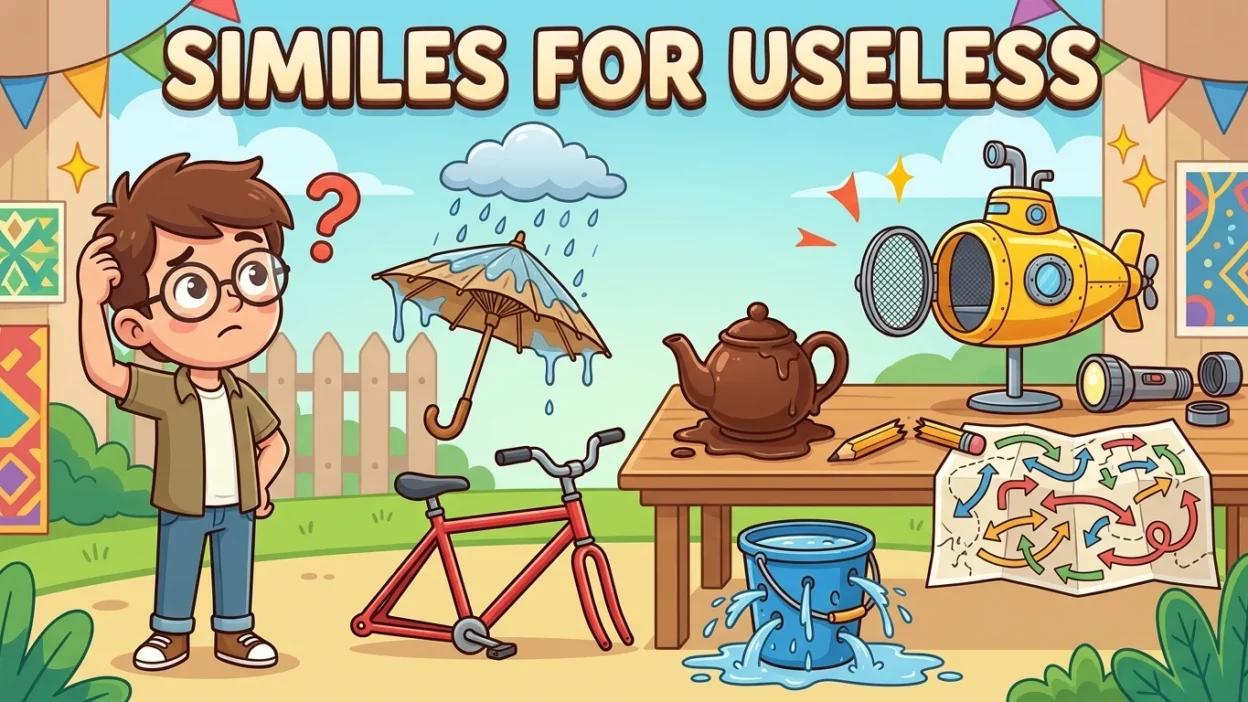
Have you ever tried to use a broken tool, followed directions that led nowhere, or depended on something that simply did not work? These moments can be frustrating, but they can also inspire some wonderfully funny descriptions. That is where similes for useless come in!
A simile compares one thing to another using words such as “like” or “as.” When describing something useless, a simile helps readers picture an object, idea, or action that fails to serve its purpose. For example, saying “the old flashlight was as useful as a chocolate teapot” creates a funny image of something that cannot do its job.
Whether you are writing a funny story, preparing a school assignment, creating dialogue, or looking for a clever way to describe a failed plan, these comparisons can help you express your ideas clearly. This collection includes similes for useless objects, failed plans, unhelpful advice, wasted effort, and everyday frustrations.
Let’s explore these creative comparisons and learn how to use them in your writing!
What Is a Simile for Useless?
A simile for useless compares something ineffective, impractical, or unhelpful to a familiar object or situation. It usually uses “like” or “as” to make the meaning clearer.
Here are some examples:
- As useful as a screen door on a submarine — completely unsuitable for its purpose.
- Like a flashlight without batteries — unable to provide light.
- As helpful as a map with no directions — offering little guidance.
- Like an umbrella full of holes — failing to provide protection.
- As effective as whispering into a hurricane — having almost no impact.
These similes can add humor and detail to descriptions of objects, ideas, and situations that do not work as intended.
1. Funny Similes for Useless
These humorous comparisons describe things that are completely impractical or ineffective.
- As useful as a chocolate teapot — unable to serve its intended purpose.
- Like a screen door on a submarine — unsuitable for the situation.
- As helpful as a broken pencil — difficult to use for writing.
- Like a flashlight without batteries — unable to provide light.
- As effective as a paper umbrella in a storm — unable to offer reliable protection.
- Like a bicycle without wheels — unable to perform its main function.
- As useful as a chocolate frying pan — impractical for cooking.
- Like a phone without a signal — unable to connect when needed.
- As helpful as a map with no labels — offering little guidance.
- Like a boat with a hole in the bottom — failing at an essential task.
- As effective as a fan in a hurricane — making little difference.
- Like a lock without a key or combination — difficult to operate as intended.
- As useful as a raincoat made of tissue paper — offering almost no protection.
- Like a clock without hands — unable to show the time clearly.
- As helpful as a ladder that ends halfway up the wall — failing to reach the goal.
2. Similes for Useless Objects
Sometimes an object looks promising but does not work. These similes are ideal for describing broken or impractical items.
- As useful as a toaster without electricity — unable to toast bread.
- Like a pen without ink — unable to write.
- As effective as a key that fits no lock — unable to open anything.
- Like a flashlight pointed at the sun — adding little useful light.
- As practical as a chair with no seat — unable to provide comfortable seating.
- Like a bucket full of holes — unable to hold water.
- As useful as a map of an imaginary city — offering no real-world directions.
- Like a printer with no paper — unable to print a document.
- As reliable as a broken thermometer — providing questionable readings.
- Like headphones with no speakers — unable to deliver sound.
- As helpful as a shovel made of jelly — unable to dig effectively.
- Like a door handle on a wall with no door — serving no practical purpose.
- As useful as a refrigerator that cannot stay cold — unable to preserve food properly.
- Like a camera with a permanently closed lens — unable to capture pictures.
- As practical as a ladder with missing rungs — unsafe and ineffective for climbing.
3. Similes for Useless Advice
Advice is not always helpful. Sometimes it is too vague, unrealistic, or unrelated to the problem.
- As helpful as telling a lost traveler to keep wandering — offering no real direction.
- Like a compass spinning in circles — failing to guide someone.
- As useful as a weather forecast after the storm — arriving too late.
- Like a recipe that leaves out the ingredients — missing essential information.
- As clear as a road sign written in invisible ink — impossible to understand.
- Like asking a broken clock for the correct time — relying on an unreliable source.
- As practical as telling a fish to climb a tree — suggesting something unsuitable.
- Like a map that points everywhere at once — creating more confusion.
- As reassuring as a fire alarm that keeps ringing — increasing worry instead of easing it.
- Like instructions written in a language nobody understands — failing to communicate.
- As useful as yesterday’s newspaper for tomorrow’s weather — not suited to the need.
- Like a lighthouse with no light — offering no guidance in difficult conditions.
- As relevant as a snow report in the middle of a desert — unrelated to the situation.
- Like a lesson with every important page missing — leaving out what matters.
- As helpful as a sign that says “somewhere” — giving no specific direction.
4. Similes for Useless Plans
A plan may sound good but fail when put into practice. These comparisons describe plans that are poorly prepared or unlikely to succeed.
- As practical as building a house without a blueprint — lacking a clear plan.
- Like sailing without checking the weather — ignoring important conditions.
- As promising as a paper boat in rough seas — unlikely to last.
- Like planning a picnic during a hurricane — overlooking obvious problems.
- As effective as a road trip without fuel — unable to reach the destination.
- Like building a bridge halfway across a river — failing to complete the task.
- As organized as a calendar with every date missing — lacking structure.
- Like baking a cake without an oven — missing an essential step.
- As reliable as a tent made of wet paper — unlikely to provide shelter.
- Like preparing for winter with a swimsuit — getting ready for the wrong conditions.
- As realistic as catching the wind in a jar — depending on an impractical idea.
- Like starting a marathon without shoes — failing to prepare properly.
- As efficient as taking the longest road to the nearest shop — wasting time.
- Like planting seeds on concrete and expecting a forest — expecting results without the right conditions.
- As complete as a puzzle with half its pieces missing — lacking important parts.
5. Similes for Useless Effort
Sometimes people work hard but use the wrong method. These similes describe effort that produces little or no result.
- Like sweeping sand off a beach — working against an endless task.
- As effective as shouting at a mountain — making no meaningful difference.
- Like filling a bucket with a sieve — struggling to keep what you collect.
- As productive as running on a treadmill to reach another town — moving without getting closer to the destination.
- Like trying to empty the ocean with a teaspoon — taking on an overwhelming task with an inadequate tool.
- As useful as watering artificial flowers — spending effort where it cannot help.
- Like digging a hole in the sand beside the tide — watching the work disappear.
- As effective as pushing a wall that cannot move — using effort without progress.
- Like trying to catch smoke with a net — pursuing something difficult to grasp.
- As productive as counting raindrops during a storm — spending effort on an endless task.
- Like polishing a window that has no glass — working on something that cannot serve its purpose.
- As useful as rowing a boat on dry land — exerting effort without moving forward.
- Like trying to stop the wind with a paper fan — using too little force for the challenge.
- As effective as writing on water — creating something that quickly disappears.
- Like running in circles to reach the starting line — using energy without making progress.
6. Similes for Useless Tools
The right tool makes a task easier. The wrong one can make the job impossible.
- As useful as a spoon for digging a swimming pool — too small for the job.
- Like using a butter knife to cut down a tree — choosing an unsuitable tool.
- As practical as a hammer made of glass — too fragile for its purpose.
- Like bringing a toothbrush to clean a football field — using a tiny tool for a huge task.
- As effective as a plastic fork for breaking rocks — not designed for the job.
- Like using a ruler to measure the ocean — attempting a task with an unsuitable instrument.
- As useful as a screwdriver without a handle — difficult to operate.
- Like using a feather to hammer a nail — lacking the necessary strength.
- As practical as a paper ladder — unable to support the task.
- Like using scissors to cut a mountain — wildly inadequate for the job.
- As effective as a paintbrush with no bristles — unable to apply paint properly.
- Like using a toy shovel to dig a tunnel — far too small for the task.
- As useful as a compass inside a sealed metal box — potentially unable to provide reliable direction.
- Like using a sieve to carry soup — unsuitable for holding liquid.
- As practical as a key made of butter — unable to perform its intended function reliably.
7. Similes for Useless Information
Not all information helps solve a problem. These similes describe details that are irrelevant, incomplete, or confusing.
- As useful as a phone book from a forgotten century — unlikely to provide current information.
- Like a library with every book missing its pages — lacking the content people need.
- As relevant as a recipe during a space launch — unrelated to the task.
- Like a map of the moon when searching for a street on Earth — pointing to the wrong place.
- As clear as fog on a dark night — difficult to understand.
- Like a dictionary with no definitions — failing to explain words.
- As helpful as a list of answers with every question removed — missing the context.
- Like a radio tuned to static — providing no clear message.
- As accurate as a rumor passed through a crowd — potentially unreliable.
- Like a textbook with its final chapter missing — leaving out important information.
- As relevant as yesterday’s lunch menu to next year’s weather — unrelated to the question.
- Like a puzzle without a picture — offering little guidance.
- As useful as an address without a street name — difficult to act upon.
- Like a clock that tells only the season — lacking the detail required.
- As informative as a blank noticeboard — providing no information.
8. Similes for Useless Work
Some work produces little value because the process is inefficient or the result is not needed.
- Like painting a wall that will be demolished tomorrow — working on something temporary.
- As productive as typing on a disconnected keyboard — creating no useful result.
- Like washing a car in a dust storm — seeing the work undone immediately.
- As useful as sweeping leaves during a hurricane — fighting an overwhelming force.
- Like building a sandcastle at high tide — creating something that will soon disappear.
- As efficient as delivering mail to an empty house — putting effort where it is unlikely to help.
- Like writing a report nobody will read — producing work without an audience.
- As practical as cleaning a window during a paint storm — choosing an impossible moment.
- Like digging a tunnel that leads back to the entrance — working without reaching a new destination.
- As useful as decorating a box that will be thrown away — investing effort in something with no lasting purpose.
- Like carrying water in a leaking basket — losing the result of your effort.
- As productive as planting seeds in a freezer — working in unsuitable conditions.
- Like repairing a road that no one uses — spending effort where it has little benefit.
- As effective as printing a document on disappearing paper — producing something that will not last.
- Like rearranging deck chairs on an empty ship — focusing on details that do not solve the main problem.
9. Similes for Useless Technology
Technology can be frustrating when it fails at the very moment you need it.
- As useful as Wi-Fi in a cave with no signal — unable to connect.
- Like a computer frozen on the loading screen — unable to finish its task.
- As responsive as a keyboard made of stone — failing to react properly.
- Like a phone with a dead battery — unable to perform its usual functions.
- As helpful as a navigation app that sends you in circles — leading you nowhere.
- Like a printer that jams on every page — repeatedly failing to work.
- As reliable as a GPS pointing into a lake — giving questionable directions.
- Like a smart speaker that understands every word incorrectly — failing to communicate.
- As useful as a camera with a covered lens — unable to capture a picture.
- Like a laptop that shuts down whenever you open a file — failing at a basic task.
- As efficient as dial-up internet during a video call — struggling with a demanding task.
- Like an alarm clock that rings after you wake up — providing help too late.
- As practical as a charger with no matching cable — unable to connect to the device.
- Like a calculator that changes numbers randomly — offering unreliable results.
- As helpful as a robot without instructions — unable to complete its assignment.
10. Similes for Useless Rules
Rules should help people understand expectations and make decisions. Poorly designed rules can create confusion instead.
- Like a traffic light in the middle of an empty field — offering little practical benefit.
- As clear as a rulebook written in invisible ink — impossible to follow.
- Like a lock on a door that has no wall — serving no real purpose.
- As practical as requiring a passport to enter your own kitchen — creating unnecessary barriers.
- Like a map that forbids every road — preventing any progress.
- As helpful as a warning sign placed after the danger — arriving too late.
- Like a stopwatch without numbers — unable to measure time clearly.
- As sensible as banning umbrellas during a rainstorm — making a difficult situation worse.
- Like a checklist with no tasks listed — offering no guidance.
- As useful as a rule that changes every minute — impossible to rely on.
- Like a gate with no opening — blocking everyone without a solution.
- As practical as a speed limit on a walking path for snails — focusing on an unnecessary restriction.
- Like a handbook with contradictory instructions — creating confusion.
- As helpful as a sign pointing toward a closed road — directing people nowhere.
- Like a key that locks every door but opens none — restricting without helping.
11. Similes for Useless Promises
Promises lose their value when they are unrealistic or never followed by action.
- Like a paper bridge over a raging river — unable to support what is promised.
- As dependable as a sandcastle in a storm — unlikely to last.
- Like a calendar made of melting ice — unable to keep its shape.
- As solid as a cloud made of smoke — lacking a dependable foundation.
- Like an umbrella that disappears in the rain — failing when needed.
- As reliable as a clock that stops at random — difficult to trust.
- Like a road sign pointing to an imaginary town — offering a destination that does not exist.
- As strong as a thread stretched across a canyon — unable to carry a heavy burden.
- Like a bridge drawn on paper — looking useful without providing a real crossing.
- As lasting as footprints on a beach at high tide — quickly disappearing.
- Like a candle promised during a power cut but never delivered — failing to provide expected help.
- As certain as a cloud promising never to rain — impossible to guarantee.
- Like a suitcase with a broken handle — unreliable when carried.
- As secure as a lock made of ice — likely to fail under pressure.
- Like a map promising a shortcut through a mountain — offering an uncertain route.
12. Similes for Useless Arguments
Some arguments do not solve problems because people repeat themselves or refuse to consider evidence.
- Like talking to a brick wall — getting no response.
- As productive as debating with an echo — hearing the same words repeated.
- Like trying to teach a stone to sing — expecting an impossible response.
- As effective as whispering into a thunderstorm — having no noticeable impact.
- Like rowing against a river with no paddle — struggling without the means to progress.
- As circular as a dog chasing its tail — returning to the same point.
- Like throwing pebbles at a mountain — making little difference.
- As useful as arguing with a closed door — receiving no engagement.
- Like a record stuck on the same line — repeating the same point.
- As convincing as a blank page in a debate — offering no supporting evidence.
- Like shouting at a mute television — expecting a response from something that cannot answer.
- As effective as using a sieve to stop a flood — unable to solve the real problem.
- Like building a case from missing evidence — lacking support.
- As productive as chasing shadows — pursuing something that cannot be caught.
- Like trying to untie a knot by pulling every strand tighter — making the problem worse.
13. Similes for Useless Efforts to Fix Problems
Sometimes the solution does not address the real cause of the problem. These similes illustrate that frustration.
- Like putting a bandage on a leaking pipe — using the wrong solution.
- As effective as mopping the floor while the tap is still running — treating the symptom without stopping the cause.
- Like painting over a broken window — hiding a problem instead of fixing it.
- As useful as tightening a screw with a spoon — using the wrong tool.
- Like patching a sinking boat with tissue paper — choosing a weak solution.
- As effective as putting a lid on a boiling pot that is already overflowing — failing to address the real issue.
- Like repairing a clock by changing its color — focusing on appearance instead of function.
- As helpful as sweeping water uphill — working against the situation.
- Like replacing a light bulb when the power is off — missing the real cause.
- As practical as fixing a broken bridge with sticky notes — using an inadequate repair.
- Like trying to cure a flat tire by washing the car — solving an unrelated problem.
- As effective as covering a smoke alarm instead of putting out the fire — ignoring the source of danger.
- Like filling a leaking boat without plugging the hole — failing to prevent repeated loss.
- As useful as polishing a broken mirror — improving the surface without fixing the damage.
- Like moving a warning sign instead of repairing the dangerous road — leaving the underlying problem unchanged.
14. Similes for Useless Things in Nature
Nature offers many imaginative comparisons for describing things that do not serve a useful purpose in a particular situation.
- As useful as a snowflake in a desert — unlikely to last or help.
- Like a leaf trying to stop a waterfall — too small for the challenge.
- As effective as a pebble against a mountain — making little impact.
- Like a raindrop trying to fill the ocean — too small to achieve the goal alone.
- As helpful as shade in the middle of the night — offering little benefit at that moment.
- Like planting flowers in a sealed glass jar with no light — creating unsuitable conditions for growth.
- As practical as a snow shovel on a tropical beach — not suited to the environment.
- Like a feather trying to anchor a ship — too light for the task.
- As useful as a leaf in a forest full of leaves — difficult to distinguish or use for a special purpose.
- Like a fish trying to water a garden — using the wrong approach.
- As effective as a breeze against a mountain — unable to change something massive.
- Like a raindrop trying to put out a forest fire alone — inadequate for the scale of the problem.
- As helpful as a flower in a sealed box — unable to fulfill its natural role.
- Like a twig trying to support an oak tree — too weak for the responsibility.
- As practical as wearing snowshoes in a swimming pool — unsuitable for the surroundings.
15. Similes for Useless for Kids
These simple, funny comparisons are suitable for children’s stories, classroom activities, and beginner writing exercises.
- As useful as a crayon with no color — unable to color a picture.
- Like a toy car with square wheels — unable to roll smoothly.
- As helpful as a pencil without a point — difficult to write with.
- Like a bucket full of holes — unable to hold water.
- As useful as a lunchbox with no lunch — missing its main purpose.
- Like a kite without a string — difficult to control.
- As practical as a raincoat made of paper — unable to keep you dry.
- Like a clock without hands — unable to show the time clearly.
- As helpful as a map without a path — not showing where to go.
- Like a balloon with a hole — unable to stay inflated.
- As useful as a spoon for catching butterflies — not the right tool for the job.
- Like a school bag with no straps — difficult to carry.
- As helpful as a flashlight with no batteries — unable to shine.
- Like a puzzle with no pieces — impossible to complete.
- As practical as wearing mittens to tie tiny shoelaces — making a simple task harder.
Simile Sentences for Useless
Here are 15 complete sentences that show how these similes work in everyday writing.
- The broken flashlight was as useful as a chocolate teapot during the power cut.
- His directions were like a map that pointed in every direction at once.
- Trying to carry soup in that basket was like filling a bucket with a sieve.
- The old printer was as reliable as a clock that stopped at random.
- Our plan was like a paper boat in rough seas, falling apart at the first problem.
- Her advice was as helpful as a lighthouse with no light.
- Repairing the leaking pipe with tape was like putting a bandage on a broken window.
- The outdated guide was as useful as a phone book from a forgotten century.
- Working without the proper tools was like trying to cut a tree with a butter knife.
- The instructions were as clear as fog on a dark night.
- His argument was like a record stuck on the same line, repeating the same point.
- The charger was as useful as a key that fit no lock.
- Trying to fix the problem without finding its cause was like painting over a broken window.
- The empty notebook was as informative as a blank noticeboard.
- The toy car was like a bicycle without wheels, unable to move as intended.
How to Use Similes for Useless in Writing
Similes can make descriptions of ineffective objects, failed plans, and frustrating situations more vivid. Follow these tips to use them well.
- Describe the specific problem: Explain whether something is broken, impractical, ineffective, or unhelpful.
- Choose a familiar comparison: Everyday objects make the meaning easy to understand.
- Use humor carefully: A funny simile can lighten a frustrating situation without insulting someone.
- Match the tone: A playful comparison works in comedy, while a more serious one may suit an essay.
- Avoid repeating the same image: Vary your comparisons to keep the writing fresh.
- Explain the result when needed: Show why the object or plan failed.
For example, instead of writing, “The instructions were useless,” try, “The instructions were like a map with every road missing.” This comparison gives readers a clear picture of why the instructions were unhelpful.
How to Create Your Own Similes for Useless
Creating your own similes is easy when you start with a clear idea.
- Identify what is not working. It might be a tool, a plan, a piece of advice, or an action.
- Think about its purpose. Ask what it should do and why it fails.
- Choose an unsuitable comparison. Imagine a tool that cannot perform its job or an object placed in the wrong environment.
- Connect the ideas with “like” or “as.”
- Check that the comparison makes sense. The reader should understand why the example is ineffective.
For example:
- Problem: A broken umbrella cannot protect you from rain.
- Comparison: A paper roof during a storm.
- Simile: “The broken umbrella was as useful as a paper roof in a thunderstorm.”
You can create countless variations by changing the object, situation, and intended purpose.
Why Use Similes for Useless?
Similes can improve your writing in several ways.
- They make ideas clearer: Readers can picture why something does not work.
- They add humor: Unexpected comparisons can turn frustration into comedy.
- They strengthen descriptions: Specific images are more memorable than vague statements.
- They develop creativity: Writers practice connecting objects and situations in new ways.
- They make stories engaging: Figurative language gives dialogue and narration more personality.
- They help explain abstract ideas: Inefficiency and poor planning become easier to understand through familiar examples.
- They support language learning: Students can practice recognizing and creating comparisons.
The strongest similes are easy to understand, relevant to the situation, and interesting enough to stay in the reader’s mind.
Common Words Related to Useless
Use these related words to make your descriptions more precise.
- Ineffective: Unsuccessful, unproductive, powerless, fruitless.
- Unhelpful: Uncooperative, irrelevant, inconvenient, unsupportive.
- Impractical: Unworkable, unrealistic, unsuitable, inefficient.
- Broken: Damaged, faulty, defective, malfunctioning.
- Pointless: Meaningless, unnecessary, futile, purposeless.
- Unreliable: Inconsistent, unpredictable, untrustworthy, unstable.
- Unproductive: Fruitless, inefficient, unprofitable, wasteful.
- Inadequate: Insufficient, unsuitable, incomplete, deficient.
- Confusing: Unclear, complicated, puzzling, ambiguous.
- Wasteful: Inefficient, extravagant, unnecessary, excessive.
Choosing a precise word can help you decide which simile best communicates your meaning. For example, “broken” works for a faulty object, while “pointless” may describe an action that has no clear purpose.
Practical Exercise: Test Your Simile Skills
Complete each sentence with a suitable simile. You can use examples from this article or invent your own.
- The broken flashlight was as useful as ______.
- The instructions were like ______.
- Trying to carry water in that container was like ______.
- The plan was as practical as ______.
- His advice was as helpful as ______.
- Working without the right tools was like ______.
- The old computer was as reliable as ______.
- Repeating the same ineffective action was like ______.
- The outdated map was as useful as ______.
- Trying to solve the problem without finding its cause was like ______.
Answers With Explanations
These are sample answers. Other creative comparisons are also correct when they fit the meaning.
- A chocolate teapot. This suggests an object that cannot perform its intended function.
- A map with every road missing. This describes instructions that offer little guidance.
- Filling a bucket with a sieve. This shows that the container cannot hold what is needed.
- Building a house without a blueprint. This describes a plan without proper preparation.
- A lighthouse with no light. This suggests guidance that is not actually helpful.
- Cutting a tree with a butter knife. This illustrates using the wrong tool for a task.
- A clock that stops at random. This describes technology that cannot be trusted.
- Running in circles to reach a destination. This represents effort without progress.
- A phone book from a forgotten century. This suggests information that is outdated.
- Painting over a broken window. This means hiding a problem instead of fixing it.
Conclusion
Similes for useless are a creative way to describe broken objects, ineffective plans, unhelpful advice, and wasted effort. Instead of simply saying that something does not work, you can compare it to a chocolate teapot, a flashlight without batteries, or a map with no directions. These images make your writing clearer, funnier, and easier to remember.
You can use these comparisons in stories, school assignments, humorous conversations, and everyday descriptions. You can also create original similes by thinking about an object’s purpose and imagining something that fails to serve the same purpose.
Which simile is your favorite? Share your own clever comparison and discover new ways to make ordinary descriptions more expressive!
Frequently Asked Questions
1. What is a simile for useless?
A simile for useless compares something ineffective or impractical to a familiar object or situation using “like” or “as.” For example, “It was as useful as a screen door on a submarine.”
2. What are some funny similes for useless?
Funny examples include “as useful as a chocolate teapot,” “like a flashlight without batteries,” and “as practical as a paper umbrella in a storm.”
3. What is a simile for something that does not work?
“Like a bicycle without wheels” is a clear example because it describes something that cannot perform its main function.
4. How can I use similes for useless in a sentence?
You can write, “The outdated instructions were as useful as a map with no roads.” This comparison explains why the instructions were ineffective.
5. How do I create my own simile for useless?
Think about what an object or action should accomplish, then compare it to something that cannot achieve the same goal. For example, “The broken umbrella was like a roof made of paper in a storm.”